Showing posts with label Chinamans Beach. Show all posts

Tuesday, 18 November 2014

The Spit Syphon (2/2)

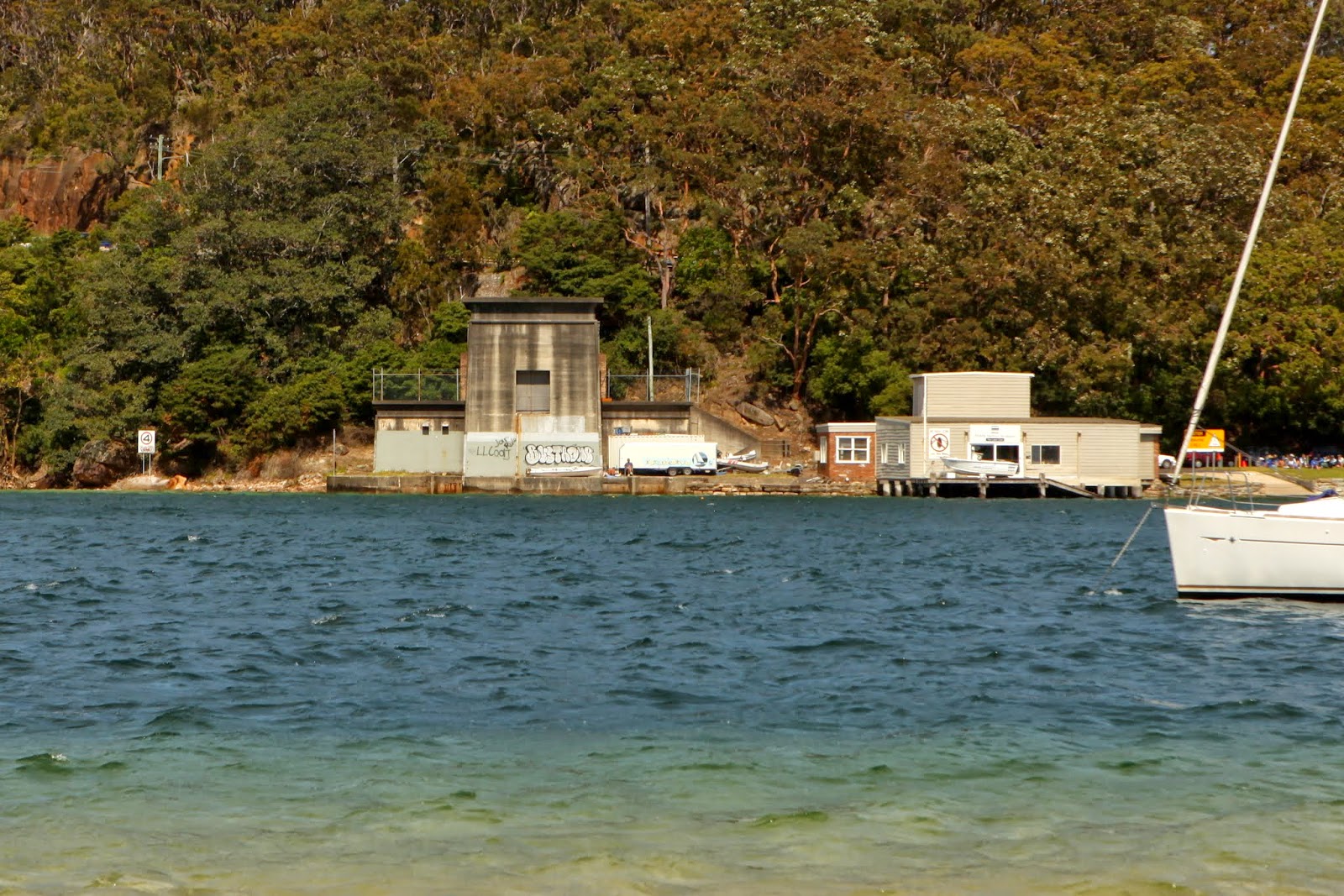
When Fig Mince drew my attention to this structure in the background of one of my Chinamans Beach photos, I figured it was a government utility of some sort, just by how ugly it was! From memory, I think I googled "utility at The Spit", which brought up a lengthy heritage assessment report prepared by Mosman Council. I went looking for Parrwirri Road, and Bingo! Got its name and its originating State Government utility. Informayion was easy after that. Lots of technical guff to read though.

I lead this second post with a closeup of the structure on the Clontarf foreshore. It is ugly, delapidated, and an eyesore - but it is an essential element in our taken-for-granted way of life.
These two shots from Sydney Water indicate the primitive conditions endured by the workers on both the under-water section (across Middle Harbour), and the tunnels through solid rock. Three men died on the tunnelling between Clontarf and the Manly outfall. The tunnel was 90m below the surface at its greatest depth, and between Manly and Clontarf nearly 163,000 tonnes of rock had been excavated. And this feat of engineering is unheard of. The men who gave their all are not feted, their heroics not sung.
I walked from the valve-house on the Clontarf shoreline, following the pipeline (which is enclosed in a box-like concrete structure) as it cuts throgh the beach reserve, and then disappears into the steep ridge behind Clontarf. In the first shot above, I am at the raer of the valve-house looking in the direction of the ocean, along the length of pipe. In the second shot above, I am standing atop the encased pipe, looking back towards the beach. A century of growth is obvious in the size of the Moreton Bay Figs.
Peering beneath a low-slung fig branch, and across the beach access road, we see the pipes going through another valve-house, and seemingly, like the Pied Piper, throgh the hillside. It is the sort of built-environment element that one can pass by every day of one's life in blissful ignorance, unaware of the service it has performed for well-nigh a century.
I found this image of the Waste Water Treatment facility at Blue Fish Point Manly (North Head) on Flickr. Sydney Water will assure us that the water that comes out of the NSOOS and pours everyday into the Pacific Ocean is 99.99% pure. I take the Mandy Rice defence.
I am indebted to the following for information on the Northern Suburbs Ocean Outfall System (NSOOS):
Manly Daily, "Three died tunnelling sewer from Manly to Clontarf", 2nd August, 2013

Sydney Water, The Spit Syphon, Heritage Item

Monday, 17 November 2014

The Spit Syphon (1/2)

The Spit Syphon "house" seen from Clotarf. The waters of Middle Harbour stretch between.

Most Sunday mornings, my girls and I go to the beach, not an ocean beach, but to two beaches within Sydney Harbour, Clontarf Reserve or Chinamans Beach. An eagle-eyed reader spotted a structure that he recalled from his 1950s childhood in the area. So, here for you, Fig Mince, some details.

Two historic images from Sydney Water. Left: Pipe ready for launching, 1929; Right: Titan crane ready for the construction

From 1916 to about 1933, the Metropolitan Water, Sewerage, and Drainage Board (MWS&DB), now known as Sydney Water, rationalised the sewerage infrastructure across the northern half of Sydney, a massive area, and a massive undertaking. Known as the Northern Sydney Ocean Outfall System (NSOOS), the infrastructure stretched from Flushcombe Road in Blacktown, through Parramatta, Ryde, North Sydney, Mosman, Clontarf, and Harbord, ending up being piuped into the Pacific Ocean off Blue Fish Point Reserve, Manly. Yes, folks ... raw sewage straight from the home to the ocean. It only took them 60 years to put a treatment plant as the last stage of the system. Mind you, it took most of those 60 years for the citizens to demand that environmental change.

Standing on the steps of the Clontarf "house" looking toward the Spit. Chinamans Beach is to the left of the photo, on the far shore.

Between Chinamans Beach and Clontarf Reserve is the entrance to Middle Harbour, regularly used by pleasure craft. Pleasure craft owned by lots of wealthy folk. The sewerage pipes were placed on the bottom of the entrance to Middle Harbour. At either end of this section were constructed two Egyptian inspired structures to cover and disguise the system.

Left: Digging into the hillside to meet the pipe coming from North Sydney; Right: the housing not long after construction.

This section was powered by a "syphon". Hence, the structure that Fig Mince recalled came to be known as "the Spit Syphon". A spit is a marine landform, meaning deposition of sand. A syphon is a means of moving liquid uphill without a pump. There is a syphon in the Lane Cove section of the NSOOS, which had "branch lines" added to it as the northern half of Sydney expanded. Lane Cove, Castle Cove, and Hornsby were three such additions.

More about the Spit Syphon tomorrow.

The housing at the Clontard end of the syphon today. It would have to be one of the more ugly strucures on the harbour. But then, all utility structures are ugly.
This is a map that doesn't do well when embiggened! There are two horizontal lines running across a map of Suydney. The top line is the NSOOS, the bottom line is the SSOOS ... guess that acronymn ...

Thursday, 6 November 2014

Chinamans Beach (5/5)

The beach lies at the head of a small stream, bordered on either side by low, but steep, ridges. There is a "bridge" over the stream remnants, probably necessary after heavy rains. The steps are on the Spit Bridge end, and the concrete path winds up the Mosman end, with that real-estate cliche, "harbour glimpses".
There are rock ledges at either end with warm pools of living molluscs. The beach is quite clean, no seaweed, no jellyfish, no stingers. The only sting is in the parking meters, at $8 per hour. But ... there is a way around that which does not require a steep trudge.

Wednesday, 5 November 2014

Chinamans Beach (4/5)

There is so much to do at this beach, not just swimming. Not just chasing butterflies.
Where the market gardens were there is a playground. And an extensive grassed area, through which the "creek" trickled, beside which the bok choy flourished. Once again, as with Clontarf Reserve, it is a family beach. People between 13 and 30 very very sparse on the sand.

Tuesday, 4 November 2014

Chinamans Beach, Mosman (3/5)

The boy - probably 8 or 9 years old - has a (partially obscured) red net. He expended copious amounts of energy dashing up and down, capturing white butterflies, of which there were plenty. His father told me he had already played a game of football, and swum the length of the beach countless times. Imagine having that cooped up in a living room!

The girl on the right is his sister. The three on the left are Alannah, and her two friends, Eleanor, and Annabel. They were all VERY impressed. Alannah wants a red net. But she wanted one last week, too, to help her scoop up jellyfish.
We were up the back of Chinamans Beach where the sand dunes had been stabilised with native grasses. The image above on the left is "Kangaroo Grass" (Themeda australis). The image above on the right, is "Hare's Tail" grass (Lagurus ovatus). The image below left is "Hairy Spinifex" (Spinifex sericeus). The hind dunes were planted with low growing forms of "she-oak", through which a short-cut has been trodden.
Running around stupid catching butterflies, and waves is not for everyone. Some like to evacuate their mind, and catch a fish.

Monday, 3 November 2014

Chinamans Beach, Mosman (2/5)

As I mentioned yesterday, access to Chinamans Beach is much more restricted than to Clontarf Reserve, which in reality is straight across this stretch of harbour. "Mr Whippy" would be hard pressed to turn a penny here.
However, some enterprising folk deliver via water. I love the name of the delivery vehicle. I was assured that there was another boat that sold coffee, but he had not arrived before I had to leave.

Sunday, 2 November 2014

Chinamans Beach, Mosman (1/5)

Chinamans Beach is directly across Middle Harbour from our usual Sunday morning haunt of Clontarf Reserve. It is very, very different. For starters, there is no enclosed pool. There are far fewer people, probably because access - and parking - are more difficult. However, we arrived at 930am and were gone just after midday.
It borders close to the description of "unspoilt", does this beach. That does not mean undeveloped. It is accessed via a kempt parkland with BBQs and playground. Perfect for kite-flying, and reading. Access to the beach itself is via a small wooden "bridge" and a bushland meander-path. And this is the view at the end. In the final photo, we are looking out towards the Heads of the main harbour itself.
In the 1840s, Chinese market gardens occupied the land behind what was known as Shell Cove. Hence, the name of the beach. The gardens were established by Cho Hi Tick on a leased grant from Captain John McLean's "Park Gate Estate".