Showing posts with label Hyde Park Barracks. Show all posts

Thursday, 3 March 2016

A "Sydney Living Museum" Pass


I have a Sydney Living Museum 3-month pass, that enables me to see four named museums for an investment of $8.

I saw the Museum of Sydney first, which is on Bridge Stree, down near Circular Quay, on the site of the first Government House. Then I went through the Justice & Police Museum, which is on Phillip Street, also down near Circular Quay. My third museum is this one: Hyde Park Barracks.


Hyde Park Barracks is on Macquarie Street adjacent to Hyde Park. It was commissioned by Governor Lachlan Macquarie, and designed and overseen by Francis Greenway. In 1817 it was ready for its first intake of convicts. From 1788 until then, convicts were mostly able to spend the night wherever they could find a roof. Where else were they going to run off too? Sydney was down the nether-end of the world! Those who did try to escape, died quickly in the unforgiving bush.


Wednesday, 2 March 2016

Beneath the Street


More and more of Sydney is beneath the streets. There are road tunnels, there are shopping malls, and there are railway stations.

This is one of the tunnels between St James Railway Station and street level. St James is beneath Hyde Park (North).


This tunnel leads towards Macquarie street, to St James Anglican Church, and to Hyde Park Barracks. It is a mass of city workers during the week, the Supeme Court of NSW being very close. But, I was there one Sunday morning.


Photo 1: A St James tunnel showing photos of its 1926 construction on the tiled walls.
Photo 2: The steps leading from the tunnel to the plaza outside St James Church
Photo 3: St James Church
Photo 4: St James taken from the forecourt of Hyde Park Barracks


Sunday, 1 November 2015

The Barracks Veggie Patch - Part 1

Hyde Park Barracks (2013) with its red-pebble courtyard. The building immediately to its right did not exist in 1819, neither did the roads, obviously. The building on the extreme, upper right is the post-1865 St Mary's Cathedral replacing the original which burnt down. Its axis was east-west, rather than the current north-south axis. The veggie patch was to the right of the cathedral.

Left: Click on this to enlarge. It is an aerial shot taken from Sydney Tower. I have circled the area that was the original veggie patch.
Right: Taken from the southern steps of the rebuilt cathedral, looking across to the Museum. College Street runs down the right of the photo. It is a very sloping area, which added to the difficulties that the colonists did not forsee.

For the first quarter-century of the life of Sydney Town, the majority of convicts were not locked up. There was nowhere to lock them into, and just where were they going to run-a-way to? But then in 1810, along comes Lachlan Macquarie (the 5th Governor), who loved design and order. He did things like straightening streets, and constructing what are now called “public” buildings. One such was the Hyde Park Barracks: to lock the convicts up into when they weren’t out slaving in road-gangs. Once locked up, they had to be fed; the cheapest way possible was the mantra. The Governor allocated 11 acres, close-by, for a veggie patch.

Left: "Sydney from Woolloomooloo" (1837)(Robert Russell)(National Library of Australia). On the left is Sydney Grammar School, then the spire of St James, then the gardener's lodge, and in the distance right is the first St Mary's. Hyde Park Barracks is the orange-walled building poking out behind the cathedral.
Right: "View of Sydney from Woolloomooloo, looking West"(1839)(Frederick Garling)(State Library of NSW). Ignore the little building in the left foreground. In the middle-distance, we have another view of the first incarnation of Sydney Grammar, then the gardener's lodge. Still too early for the Museum. However. running down beside the lodge, and heading toward us is William Street, and the stone-bridge over the Yurong Stream. Way over in the background, on the right, stands the spire of St James, and to its right, St Mary's. There are walking paths criss-crossing the relatively steep field.

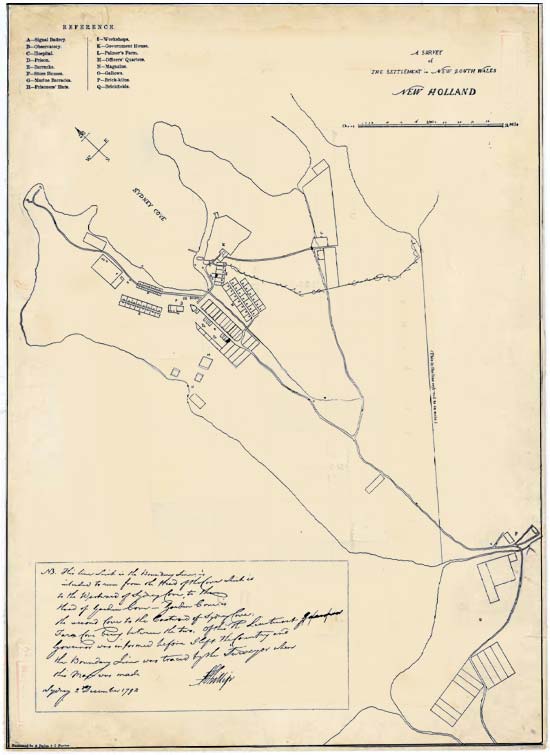
The first governor, Arthur Phillip, had determined a town boundary in 1792, just prior to his return to England. The barracks were close to the eastern edge of this boundary, an edge that was being rapidly populated with imposing government buildings, and parklands dedicated to both military use, AND the hoi-polloi. The veggie garden was constructed in 1819, after the area was denuded of its “forest” of Angophora costata (a native gum tree) and Eucalyptus pilular (a Blackbutt). It was the eastern limit of the Turpentine-lronbark forests supported by the underlying Ashfield Shale soils. The colonists were deluded into thinking that if the land supported all this natural vegetation, it would grow turnips, and carrots, and parsnips, and pumpkins, as well as potatoes and onions: all the ingredients for soup. By 1831, the experiment had failed, and the land left vacant.

Left: "A Survey of the Settlement" (1792)(Governor Arthur Phillip)(???). This is Phillip's "boundary line" inside which all the land was government land, and NOT to be given in grants to settlers. Typically Australian, future governors and civil servants overlooked this dictat.
Righr: "Plan of the Town and Suburbs of Sydney" (1822)(State Library of NSW). The site of the convict garden is laid out in a grid just off-centre, and numbered "40". To the right is heading east.

We now know this area as Cook+Phillip Park, between St Mary’s Cathedral (foundation stone laid 1821) and the Australian Museum (building work started in 1846) which is bounded primarily by College Street (street constructed in 1832) and William Street (construction commenced in 1836). The veggie garden pre-dates all four of these locators, occupying some of the Sydney Grammar land, most of the Museum land, the start of William Street, and much of the cathedral forecourt. However, it now exists in historic documents only. There is nothing on the ground as evidence that it existed at all.

Left: Photograph of the Gardener's Lodge (1880)(Australian Museum Archives). This is the only knpown photograph. There are artistic interpretations, as I have indicated. The lodge is the octagonal building on the right.
Right: Click on this 2013 photo of the Museum, in an aerial shot from Sydney Tower, I have included a big red X about where the lodge was located. In the 2015 rejuvenation of the Museum entrance, this spot has been overwhelmed by the "floating glass Crystal Hall" which I personally find under-whelming.

There had been physical evidence – once upon a time. The gardens were laid out as one would expect from those accustomed to English gardens: a large square divided by walkways into four (smaller) squares, with a central circle, and in this central circle, stood the gardener’s lodge. The octagonal lodge was located at the NE corner of the first Museum building which was opened in 1857. The lodge was constructed c. 1820 when hopes for the success of the venture were high. It was demolished between 1880 and 1885, in preparation for major remodelling of the two existing Museum buildings, and the construction of the third (southern) wing. It had been occupied by a police constable and his family in the 1840s, and then used by the Museum as a taxidermist’s workshop until c. 1865, when it was converted into a kitchen and wash-house. It was single storey, with a central chimney, made from brick and stucco, with a shingle roof.

Left: Frontispiece to "A History of NSW: From its Settlement to the close of the Year 1844" (1844)(Braim, TH)(Caroline Simpson Library & Research Collection, SLM/HHT). This appears to be a view from College Street, looking north-east over Woolloomooloo Bay. the Potts Point ridge, with Garden Island and Port Jackson.
Right: "Panoramic View of College Street and Hyde Park" (1867-1870) (Johan Nepomuk Degotardi)(State Library - NSW). The western swathe of the Convict Garden is, at least, fenced it, and appears to be hosting a couple of goats.

The convict garden was no more, but the "parkland" remained in government hands, being hived off for a range of uses until 1998. Sydney Grammar was allocated the southern-most portion beside the Francis Forbes allotment. Beside that, land was ear-marked for the Australian Museum, and behind that, one of a number of National Schools. A strip was used to widen the top-half of William Street, some temporarily given to the Blind Institute, some to the Hyde Park Nursery, and some allocated to a lawn-bowling club. Not only did the garden go to rack'n'ruin, but Hyde Park Barracks did not fare much better, until the 1970s, when a new civic awareness, and a respect for our convict heritage blew through the town.


"Looking south-east from the tower atop St James" (1871)(Supplement to Illustrated Sydney News)(State Library - NSW). The cathedral is a burnt shell. The northern side of the Museum is obscured by dense brush. The diagonal walking track through the convict garden is now a road for carts and gigs.

The Barracks Veggie Patch - Part 1
The Barracks Veggie Patch - Part 2 (coming soon)

References

"Lost Convict Lodge Rediscovered"

"The Convict Vegetable Garden that never really was"

Research Skills in Practice (2013) (Matthew Stephens, SLM)(Museum of Sydney)

The Sydney Gazette (8 May 1819)(P1-2)

Heritage Assessment: Cook and Phillip Parks (March 1997)(Lawrence Neild and Partners, Australia Pty Ltd)(Spackman & Moss Pty Ltd)(University of Sydney)

Etheridge, R., 1919. The Australian Museum—fragments of its early history. Records of the Australian Museum 12(12): 339–400, plates xlv–xlix. [4 December 1919]

The Domain: Volume 2 - Cultural Landscape Study (Royal Botanic Garden and Domain Trust)(Rosemary Annabel)

Cook+Phillip Park(City of Sydney)(March 2013)


Friday, 24 January 2014

Sydney from on high (1)

On the left, surrounded by red pebbles, Hyde Park Barracks, commissioned by Governor Lachlan Macquarie, 1818.
Top centre: St Mary's Roman Catholic Cathedral, foundation stone laid 1868.
Middle centre: Archibald Fountain, erected 1932.
In and around Hyde Park North, set aside for public recreation by Governor Macquarie in 1810.
Taken from the observation level of Sydney Tower, Pitt Street, Sydney Australia.

Thursday, 30 June 2011

Redcoats & Convicts Festival - Living history


Up on the third floor of The Barracks is the hammock room. This is a brilliant idea by the historians to bring history to life. Classes of school children, and community groups, are invited (for a cost!) to stay over for the night and experience life as we think it may have been for the early inhabitants of our city.


Hyde Park Barracks was a form of gaol. I guess. This is where convicts were housed durng the night and before they went out on their work gangs over Sydney town. It housed convicts for only 30 years. Only! It must have seemed an eternity to those poor blighters.

When it was converted into a museum in the 1970s and 80s, it was stripped back and everything under the floor boards saw the light of day. I got a real feel for the paucity of their existence as I wandered the rooms. Sydney Town at that time sprang to life in my imagination. Sydney has a short history, and its early population could be regarded as the 'dregs' of London of the time. However, those years from 1788 to 1821 set the national psyche up until more recent times.


As I stumbled back out into the sunshine of the present, I came face to face with a couple singing along to the drone of a hurdy-gurdy. This instrument is not everyone's cup-of-tea, but it does recreate the sounds of the times. A Hurdy Gurdy is a wheel fiddle. The sound is made by hand cranking a wooden wheel that acts as an endless violin bow, sounding drone strings and melody (chanterelle) strings. Wooden tangents are pushed against the melody strings, stopping them at different points to produce the different notes. Note the marvellous head on this model.

Wednesday, 29 June 2011

Redcoats & Convicts Festival - Feeding the People


There was little reference to loaves and fishes in the struggling young colony; indeed, the first decade was one of unremitting famine and paucity. Crops failed. Ships did not appear over the horizon. Neither soldier nor free-settler was suited to growing vegetables, or wheat, or husbanding cattle or chickens. And water supply in this driest of dry lands was tenuous after the be-fouling of the sorry Tank Stream. Indeed, it was not until the tenure of the 5th Governor, Macquarie (1810-1821) that the future of the colony was assured.

So what was the diet in those early days?


The meat was mostly pig and chicken - although both were considerably more scrawny that the delightful critters being cuddled here! And this, even though Sydney was sited on a waterway teeming with fish, and the literature abounds with line-drawings of indigenous peoples fishing. Salting was a preservation method much indulged.

Scurvy was rampant well into the 19th century. Vegetable gardens had failed on Garden Island, within the Domain and along the eastern perimeter of land carved out or Hyde Park - where St Mary's now stands. However, individuals were more successful in their back gardens and in communal plots. Nowadays, we have come to expect 'perfect' fruit and vegetables, rejecting those with blemishes and wonky growth. Back in the early days though, food was desperately short, and anything was better than nothing. Pickling was a preservation method much indulged.

Tuesday, 28 June 2011

Redcoats & Convicts Festival - Traditional skills


The Colony of New South Wales was established in 1788, peopled by convicts, soldiers and a few free settlers. In 1819 Hyde Park barracks was built by gangs of convict labourers to house convicts who, up to this time, has to make their own sleeping arrangements each evening in the town.

Both convict and soldier, free-settler and emancipated-convict worked with their hands, with their brawn, using raw materials, and methods handed down through the ages.


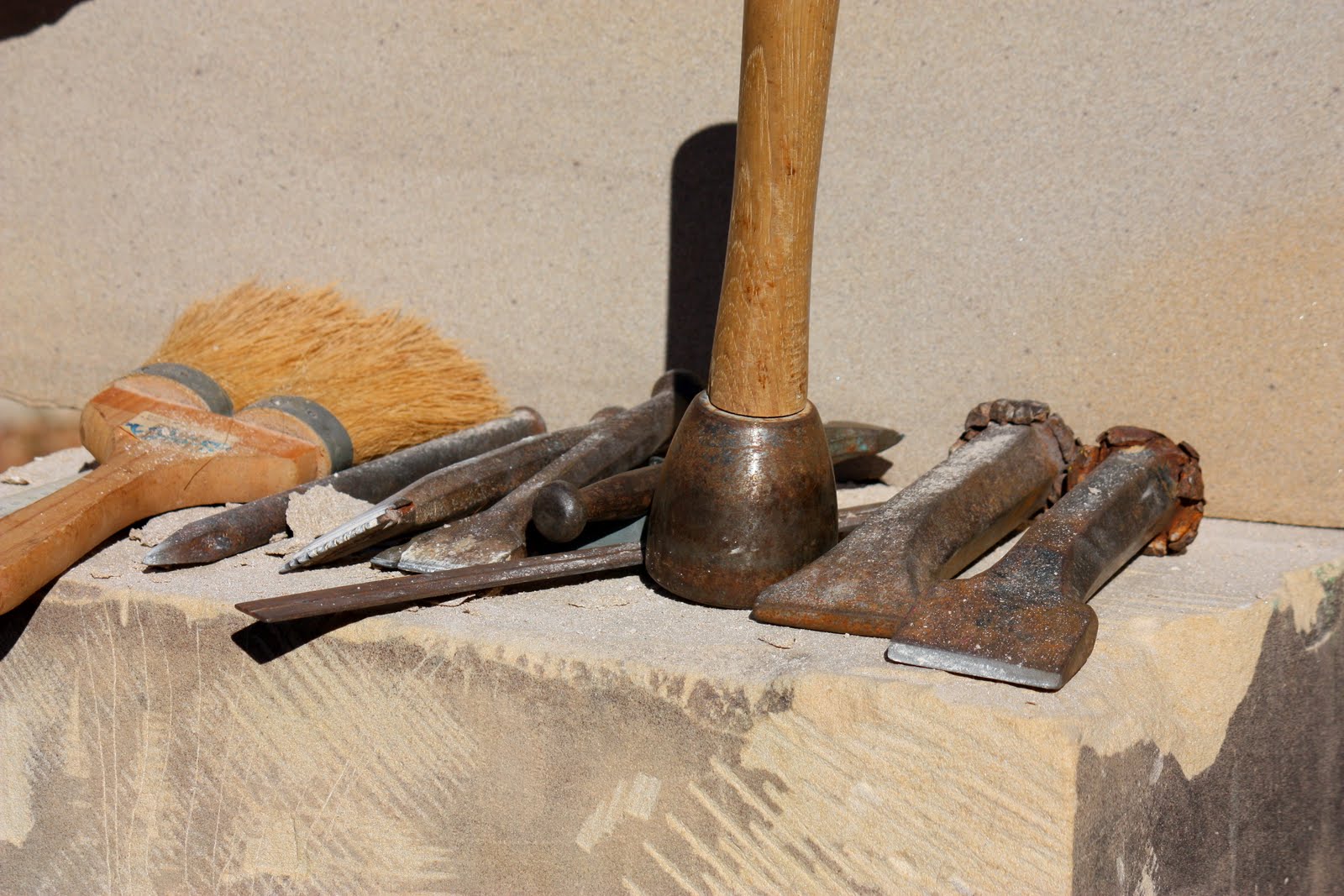
This was before the time of the great enclosures in Britain, before the growth of the industrial towns, and the drift of farm and village workers to new horizons. Youngsters dreamt of being an apprentice, of graduating to a journeyman, and finally becoming a master of their craft. At this festival just a few crafts were hightlighted: masons, blacksmiths, and cordwainers. But Sydney-town would have resounded to the work of weavers, farriers, scriveners, wheelwrights, tanners, chandlers, loriners and mercers, among others.


As I watched these master craftsmen ply their trade, I thought of books dear to me like Flora Thompson's 'Lark Rise to Candleford', 'The Stone Quartet' of Alan Garner (especially 'The Stone Book' and 'The Aimer Gate'), and even Bruce Chatwin's much later 'On the Black Hill'. All giving a flavour of a bygone era and that which is lost. Not that I decry progress; nor am I a luddite, wanting to replace blackberries with smoke signals.


Within the HPB's museum, there is a story noting that a number of fathers, sons and brothers passed through the building. Whether any had deliberately committed offences in order to reunite families is speculation. Four example, four Reilly brothers were transported from Ireland. Luke, a tailor, was sentenced for street robbery. Peter, an illiterate stone-cutter, was sentenced for stealing flannel. Francis, a shoemaker, was transported for pickpocketing. They were later joined by another brother, Thomas. This new land offered them greater opportunities than the old.

Monday, 27 June 2011

Redcoats & Convicts Festival - Musket firing


Today was a Festival of Redcoats & Convicts at the Hyde Park Barracks which opened in 1819 to house convicts and closed in 1848. Directed at young families, the day (a glorious 21C) had a range of hands-on activities for children, and genuine tradesmen plying their trade in the courtyard: masons, 'smithies, saddlers, and seamstresses.


Being regaled in the sun with a glass of cold riesling, old English folk-songs wafting on the wind, and scurrilous convicts weaving in and out the table, doing a bit of general thievery, made for a glorious Sunday, which I will share with you for the next couple of days.

Friday, 9 July 2010

The escape of the cracksmen


In 1836 a gang of four petty crims blasted open the safe in the London Custom's house and scarpered with 4,370 quid. Ready to live the high life, they cum a cropper when one of their lot was busted for another misdemeaner and to save his lousy neck, squealed. They was sentenced to def, but twas commuted to live at t'other end of the known world.
Swinging in the hammocks on a cold and wet winter's day in Sydney Town, we listened to their story on the top floor of Hyde Park Barracks. They pretty soon clocked to the fact that HPB was neither fenced nor policed. They was free to come and go - so they went. Well two of em did - the other two were lost in the mists of history.


Jumping puddles the 50 or so intrepid history buffs, followed the cracksmen down the streets of Sydney Town and caught a ferry out into the cove, under the bridge and out to the penal settlement on Goat Island. We chased them all over the island, along with the hapless Seargeant from the 4th Regiment of the King's Own Rifles, his two young privates, plus his Master-o-the-cat-o-nine-tails (it's school holidays here at the moment, so these young lads had a ball).

This is the way to get the populace involved with history: dramatise a vignette involving the story of real people. The tour guides and the professional actress were absolutely terrific. I will go to each and every one of these that they create.

Terrific collaboration between the Historic Houses Trust and the National Parks & Wildlife service.

Bravo!