Showing posts with label Goat Island. Show all posts

Sunday, 18 October 2015

Waterview Wharf Workshops, Balmain


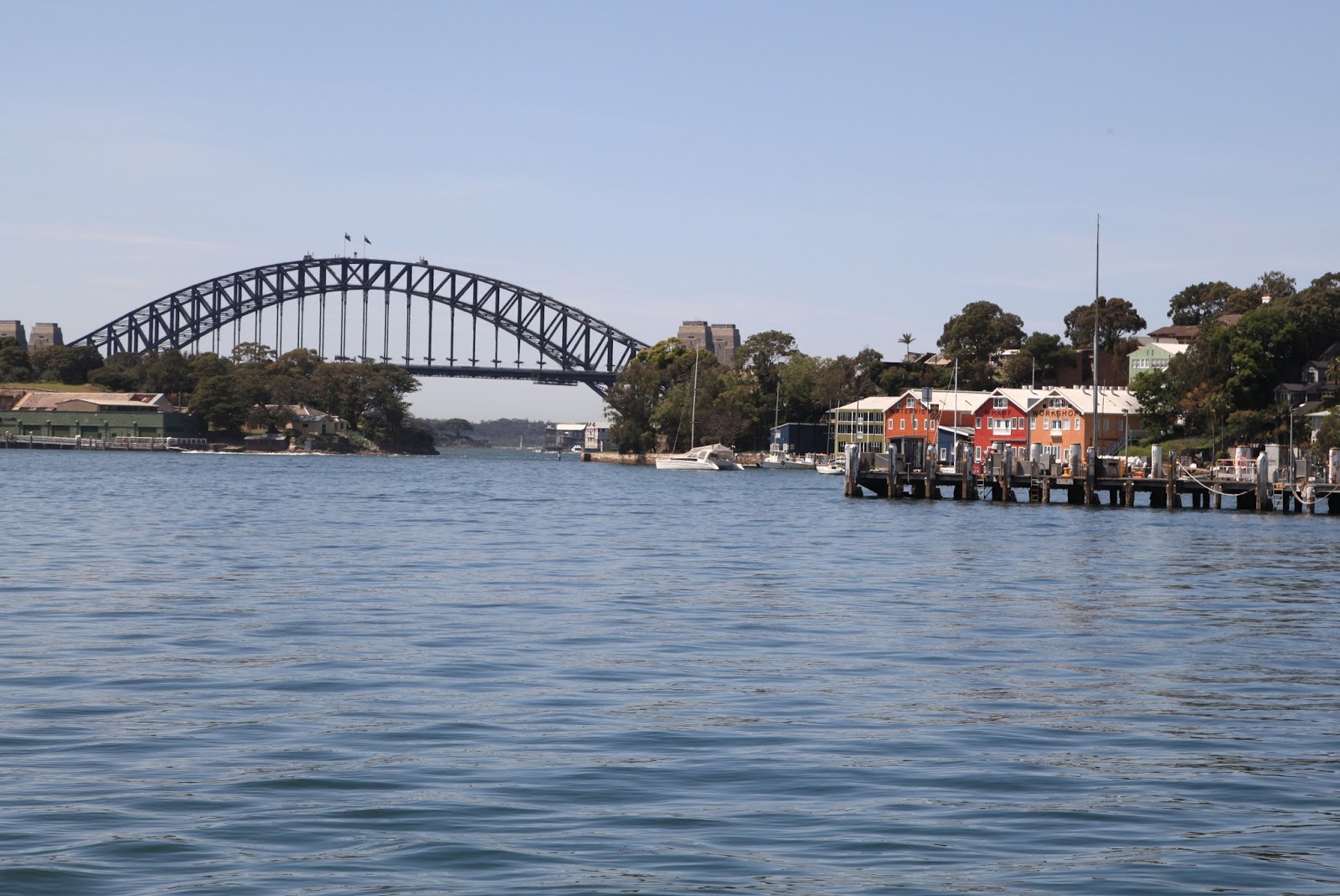
Waterview is the 19th century name for Mort Bay, around which nestles the inner-city, trendified suburb of Balmain. The workshops are privately owned, and restored, but have been listed by The National Trust. Full details are available at their web-site.

I love the texture of the water in this first image.


This is very close to the city, although it may not appear so. Just around the Balmain peninsula, and to the right ...

The bridge is softened, once again, by Goat Island and its old ship maintenance workshops. This is a wonderful ferry ride, showing a working harbour.


Wednesday, 14 October 2015

Turn left down the harbour ...

Where are we going today, Mr. Nicholson?
Where is the going to be?
Don't turn left, turn right down the harbour
And out to the open sea.
This is the refrain to Bernard Bolan's "Rose Bay Ferry", but it is applicable to nigh every vessel that plies its trade on Sydney Harbour. Except, from Greenwich Point Wharf, one turns left to head for the open sea.


The first two images are turning left (east) and show the skyline, and the obscured bridge. Goat Island has a fairly okay location!

The next two photos, after the shot of the basic Greenwich Point Wharf, are looking across to Cockatoo Island, which was a convict island, and then a ship-building island.


Friday, 9 October 2015

The CBD - From a Distance


The city is on the south-side of the harbour. Greenwich (gren-ich) Point is on the north-side of the harbour. We are looking south-east. It is about 9am last Monday, a Public Holiday here in New South Wales.

Greenwich Point baths are new to me. They are a small, fenced, harbour pool; pay for entry. Parking is not easy to come by. Access is steep. It is a delight, and the views are to die for.

They have a "Nippers" programme which starts on 1st November, so I am assured we will be back.

A note on the first image. There is a forested area immediately before the high-rise of the CBD. This is Goat Island.


Tuesday, 3 June 2014

The "Phoenix" hulk

Phoenix Hulk moored at entrance to Billy Blue's Bay [Lavender Bay] : Robert Russell c. 1837
Sketch courtesy of the National Library of Australia, Canberra
In all its years as a penal colony, 1788 to 1840, there was only ever one hulk moored in Sydney's harbour, that of the "Phoenix", which was hove to in the triangulation of Dawes Point, Lavender Bay, and Goat Island, between 1825 and 1837. Governors Brisbane, Darling, and Bourke found it furthered their aims:
  • the presence of the hulk flashed a warning to recalcitrant convicts;
  • the hulk took the pressure off the overflowing gaol at Circular Quay (Sydney Gaol); and,
  • the 260 felons on board were an easily deployed iron' gang for use on either Goat Island, or the rutted tracks throughout the burgeoning township.
Standing on Dawes Point, hanging over the railing of Pier One, here is the triangulated area nearly 200 years later. Imagine the "Captain Cook Cruises" vessel as the "Phoenix", being close enough to "X" marks the spot. To the left of the image, Goat Island sneaks its nose in, to the left of the fuel barge.
The fuel barge continues to chugg down the waterways of the harbour, and exit right. Leaving Goat Island centre stage. The evidence of the relationship between the island and the hulk, is scattered every-which-where on the island, together with the fingerprints of Governor Richard Bourke.
A pivot on my heels, together with a few dollysteps, and my Dawes Point location becomes apparent.

Below are two annotated images to help you orient yourself. Both images, courtesy of The Graeme Andrews Collection at the National Maritime Museum.

Friday, 9 July 2010

The escape of the cracksmen


In 1836 a gang of four petty crims blasted open the safe in the London Custom's house and scarpered with 4,370 quid. Ready to live the high life, they cum a cropper when one of their lot was busted for another misdemeaner and to save his lousy neck, squealed. They was sentenced to def, but twas commuted to live at t'other end of the known world.

Swinging in the hammocks on a cold and wet winter's day in Sydney Town, we listened to their story on the top floor of Hyde Park Barracks. They pretty soon clocked to the fact that HPB was neither fenced nor policed. They was free to come and go - so they went. Well two of em did - the other two were lost in the mists of history.


Jumping puddles the 50 or so intrepid history buffs, followed the cracksmen down the streets of Sydney Town and caught a ferry out into the cove, under the bridge and out to the penal settlement on Goat Island. We chased them all over the island, along with the hapless Seargeant from the 4th Regiment of the King's Own Rifles, his two young privates, plus his Master-o-the-cat-o-nine-tails (it's school holidays here at the moment, so these young lads had a ball).

This is the way to get the populace involved with history: dramatise a vignette involving the story of real people. The tour guides and the professional actress were absolutely terrific. I will go to each and every one of these that they create.

Terrific collaboration between the Historic Houses Trust and the National Parks & Wildlife service.

Bravo!

Wednesday, 19 May 2010

Goat Island - The Queen's Powder Keg

A unique design in the wall ensuring that the building imploded if there was a 'problem'. He explained how it worked but ... duh!
Goat Island's usage can be neatly categorised by century.

During the 19th century it housed convicts who were used to quarry and cut the sandstone for use on the island and in the town. The strutures so built were used to house gun-powder.

During the 20th century the island was used to house water and police patrols and extensivley as a ship-building dock.

During the 21st century the island will be used as a vehicle to introduce the people of the city to their own history.

Left: 1870 photographed to the south from the north shore showing Balmain behind the island;
Right: about 1910 once again from the north shore but this time more in a SEE directon showing Balmain and part of Darling Harbour
The quarrying commenced in 1826 when Governor Darling moored the hulk Phoenix off the island to use its convicts as labourers to build a naval arsenal. However, its use as a quarry, although intensive, was short-lived when the new governor, Bourke and Thomas Mitchell realised they would end up with no island at all!

There was a need to store the huge quantities of highly explosive black gunpowder used around the town, and the island was perfect. As hundreds of wooden barrels were required for storage, coopers and a cooperage were also required.

Top Left: the walls and buttresses of the powder magazine;
Top Right: The cooperage along a hewn sandstone wall
Below: the facade of the Queens Powder Magazine.
George Barney was the engineer in charge from 1836. He had already constructed Victoria Barracks, Circular Quay and completed Busby's Bore. Progress was slow as the 171 convicts only worked hard enough to stay out of stife, had to wear shackles and were shipped on and off each day. Barney solved all these issues. He's one of my heroes this bloke. The works were completed by the end of the decade and the convicts moved on to hacking away on Cockatoo Island - another beaut day trip.

The inside and structure of the magazine. The guide, David, was well informed, enthusiastic and had a great sense of humour.
In 1861 there was over 7,000 barrels of gunpowder stored on the island – equal to about one million pounds of gunpowder, enough to blow half of Sydney sky high.

Left: aerial view in 1951; Right: aerial view in 2002
National Parks & Wildlife is readying the island to open to the general public by regular ferry from CQ, probably by the end of 2010. In the interim, they are open to groups. I went with a group from the Maritime Museum. Early in July I am going with a Historic Houses group for a dramatised day linking Hyde Park Barracks with Goat Island entitled 'Escape of the Cracksmen'. Hope they dress up!!
The view from Goat Island early in 1930