 |
| "Alexander" pulls into King Street Wharf #4 in Darling Harbour. I took this shot from Wharf 7, Pyrmont, and then hoofed it around to ride the "Alexander" from Casino Wharf back to Circular Quay. |
|
| "Alexander" pulls into King Street Wharf #4 in Darling Harbour. I took this shot from Wharf 7, Pyrmont, and then hoofed it around to ride the "Alexander" from Casino Wharf back to Circular Quay. |
 |
| Same bridge as yesterday, different angle. You will note, of course, that Pyrmont Bridge is now motorised-vehicle-free. Even the exceedingly ugly Monorail has been removed. With both my shots, I am facing east. Instead of being predominantly a working harbour, Darling Harbour - which the Pyrmont Bridge spans - is now predominantly a leisure and tourism harbour. The restored pub, the Dundee Arms, is tucked in on the other side of that massive white rectangular building on the further shore. |
 |
| This 1907 image shows the working habour past, of both Darling Harbour and the Pyrmont Bridge. Pyrmont is immediately to the west of the bridge, ie at my back. It provided much of the sandstone for work in the immediate vicinity, and for the CBD, from quarries with the romantic names Paradise, Purgatory. and Hellhole. In the B&W image, clearly visible on the horizon are (from L to R): the dome of the Queen Victoria Building, the clock tower of the Sydney Town Hall, and the double western buttresses of the Anglican Cathedral, St Andrews. The view ach and every one of these landmarks from the Pyrmont Bridge today, is obliterated by developments since 1907, as one might reasonably expect. |
 |
 |
| The first Pymont Bridge, across Darling Harbour, was opened in 1858. It was wooden. It was replaced in 1902 by this steel bridge. Both versions had a swing span which opened to allow the passage of tall ships. |
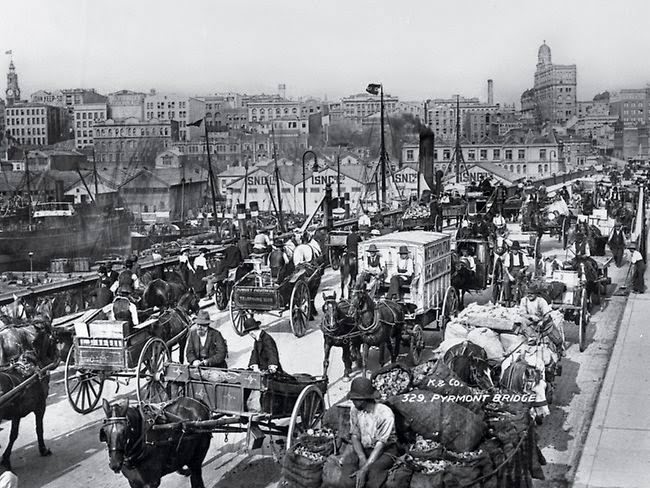 |
| The "Then" shot was taken by Charles Kerry, and is part of the Tyrrell Photographic Collection at the Powerhouse Museum. They estimate it was taken between 1902 and 1917. I walked across on a most blustery day, and the span swung open behind me. My shots were taken facing east. The structure across the bridge(the little house) is the control room for the opening span. |
 |
 |
| The Dundee Arms started life adjacent to the Corn Exchange in Sussex Street North. It backed onto the Market Street Wharf, which was by far the biggest wharf in Darling Harbour of that time. It is now a part of the Sheraton Four Points hotel, which refurbished it in 1991. Prior to that and for most of the 20th century it was in a very poor state. In 1907 it was converted into office space, and the first floor verandah removed. Between 1927 and the early 1970s (when the wrecking ball for the Western Distributor started to swing), it was known as Kermac House. |
 |
| The Dundee Arms was built by John Robertson in 1860, who hailed from Scotland. A timber merchant, he had purchased the plot in 1847 for just over ₤212. Where the deck is now (along the southern wall) which is a quasi beer-garden, was Wharf Lane which joined to the currently non-existing Wharf Street which disappeared with the creation of Day Street in 1906, as a consequence of the massive demolitions caused by the bubonic plague. The left 1860 image shows the Robertson family posing with their newly-built hotel. John is sitting on the stoop. Note the steep fall-away of Wharf Lane, as it then was. The right 1983 image shows Wharf Lane, and the nearly unrecognisable "Dundee Arms" dressed in its very sad guise as KERMAC House. Wharf Lane is still there behind the cyclone fencing. Wharf Lane is still there today, just beneath some decking, otherwise the lower cellars are inaccessible. |
 |  |
 |
| "The Bristol Arms Hotel" has been at 81 Sussex Street since 1898. The area along the western side of Sussex Street was occupied from an early date with houses. The Sands Directory records the site of the Bristol Arms occupied by Henry Ash (carpenter) in 1860. "The Bristol Arms Hotel" first appeared in 1865-66 at No. 69 Sussex Street. The area immediately behind the hotel was the Darling Harbour waterfront occupied by the Patent Slip Wharf since c.1833. Sussex Street was the main thoroughfare between the wharves and the town. |
 |  |
| The Sands Directory lists John Booth as licensee (1865-66), then James Blair (1867-69). Francis Blair succeeded him between 1870-1886. The hotel was operated by a succession of publicans between 1887 to 1905. In 1906-08 the hotel was run by Ellen Keyes and named "Keyes Hotel", but reverted to the name Bristol Arms in 1907. The building continued to function as a hotel until 1969, when the property was resumed by the Department of Main Roads as part of the realignment of Day Street. From this point it became known as the Welcome Inn Hotel. The property was put up for sale after 1984 and once again, renamed "The Bristol Arms Hotel". |
| Text sourced from NSW Office of Environment and Heritage Next post: "The Dundee Arms" |
 |
 |
| Approximately half of the natural foreshore of our harbour has been replaced by seawalls of one type or another. This seawall is directly in front of "The Star" casino in Pyrmont. Since 1788, Pyrmont has gone from bush, to cow "pasture", to rock quarries, to a blighted industrial landscape accompanied by a plethora of wharves and shipping facilities. This wharf has at least three layers: sandstone on the bottom, then concrete blocks, all topped with a couple of rounds of bricks. The fact that it is vertical causes its own problems with wash, and bio-diversity. To the best that I can determine, the lower level of sandstone was constructed after 1876, after the Sydney Council Health Committee toured the streets, and condemned a range of sub-standard housing which was continually being inundated by tidal flushes. |
 |
| This is the seawall in Pyrmont Bay, which is part of Darling Harbour, which, in turn, is part of Port Jackson. Port Jackson includes North Harbour, Sydney Harbour, Middle Harbour, the Lane Cove River, and the Parramatta River. It has a perimeter which is 317 kms in length. |
 |
 |
| If I had to leave Sydney forever, what would I miss? I have canvassed a range of regrets I would have should this occur, until it finally dawned on me that I would miss Sydney over three-dimensions. On a 2-dimensional axis, I would miss the centre of Sydney: from Sydney Cove in the North, to Central Station in the south; from Macquarie Street in the east, to the shore of Darling Harbour in the west. But adding a third dimension is the crucial element for me, and that is time. I would miss my search for understanding the people and places of my city through time, from 1788 through to 2015. And what better place to ponder all this history than on the shores of Sydney Cove, where European settlement commenced. Kicking back with a Stonefish Riesling, and a Roast Pumpkin, Macadamia nut, and goat's cheese salad, watching the myriad of vessels plying their trade under a summer sky. |
 |
| To see how other City Daily Photo bloggers have interpreted the Theme Day for February, follow this link. |
.JPG) |
| Looking west, we trace the line of the harbour as it ceases to be Port Jackson, and becomes either the Parramatta River or the Lane Cove River. This is the water that you see over where I was unable to avoid the reflections from the rounded windows. There are two expanses of water closer to us, and more in front. Immediately in front of my camera position is the entrance to Darling Harbour, which projects into the landform called Cockle Bay. The building with the white roof is the National Maritime Museum, which is alongside the Pyrmont bridge, which still carried the monorail in September when I took this set of images. Follow the bridge along what appears to be a tree-lined street. See the two pylons of the ANZAC Bridge which spans the entrance to Johnson's Bay, Glebe, to the left of the bridge? It is a glorious walk around the Glebe foreshore in the early mornings with the city providing a near-quiet and un-busy back-drop. From the observation level of the Sydney Tower, Sydney, Australia. |
 |
| This is my contribution to the Skywatch Friday Community. |
 |
 |
 |
 |  |
 |  |
 |  |
 |  |
 |  |
| I must go down to the seas again, to the lonely sea and the sky, And all I ask is a tall ship and a star to steer her by, And the wheel's kick and the wind's song and the white sail's shaking, And a grey mist on the sea's face and a grey dawn breaking. I must go down to the seas again, for the call of the running tide Is a wild call and a clear call that may not be denied; And all I ask is a windy day with the white clouds flying, And the flung spray and the blown spume, and the sea-gulls crying. I must go down to the seas again, to the vagrant gypsy life, To the gull's way and the whale's way where the wind's like a whetted knife; And all I ask is a merry yarn from a laughing fellow-rover, And quiet sleep and a sweet dream when the long trick's over. |
| John Masefield |
 |
 |  |
 |
 |  |
 |
 |
| David Moore's photographs of the Columbus Line |
 |
| The National Maritime Museum is in Darling Harbour beside the old Pyrmont Bridge beneath the three arcs on the RHS |
 |
 |  |
 |