Showing posts with label Birding. Show all posts

Monday, 15 November 2010

Harbourside dining


Down here, under the 'boardwalk' of Circular Quay, the underbelly of life chuggs along as best it can.

Sunday, 24 October 2010

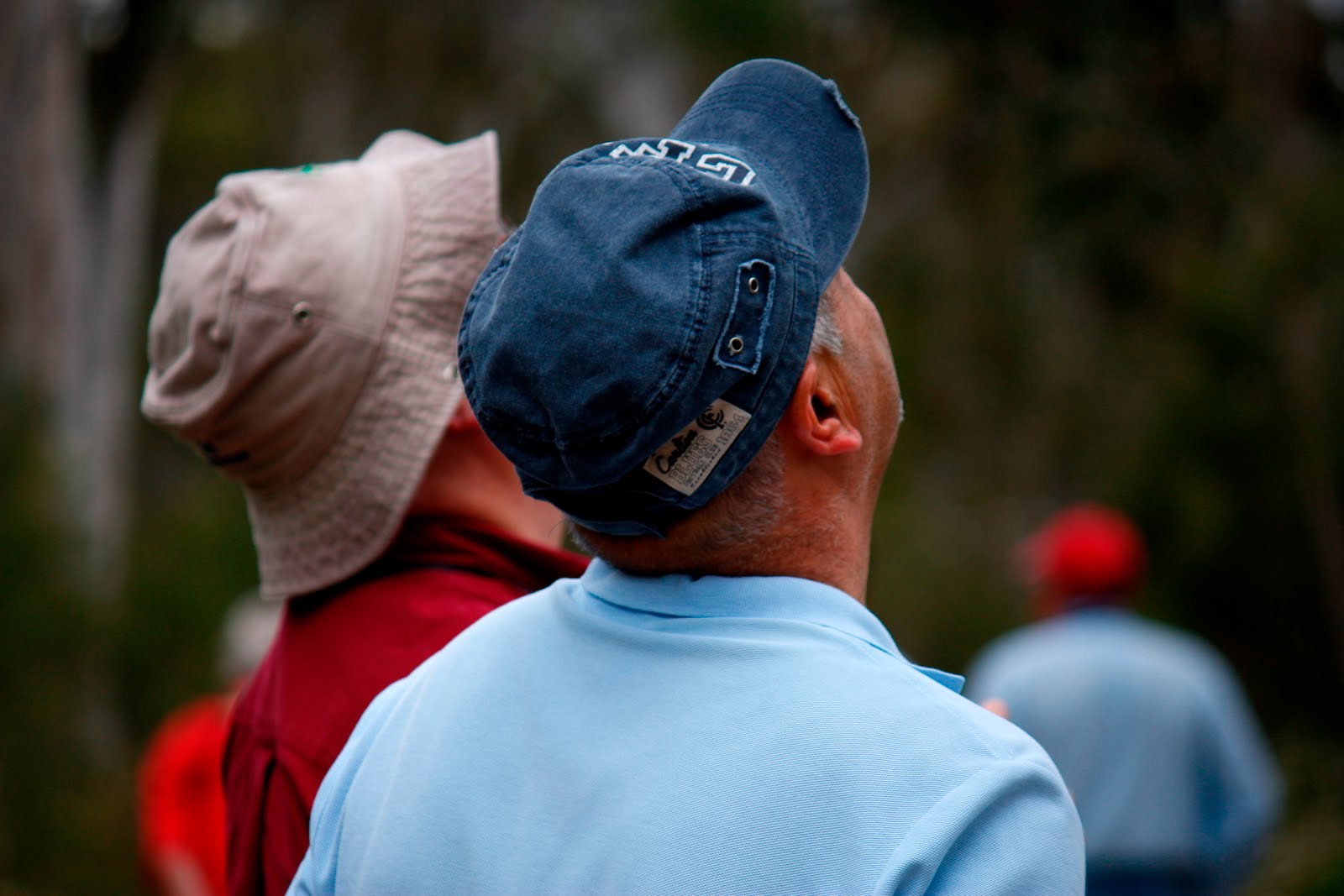
Birders - a breed apart


Generalising, birders are frequently aged geeks! I am proud to be part of their rank!

Today I took the Follow that Bird bus with ten other birders, and together with our guides, Janene and Edwin, drove up to Howes Swamp in the Yengo National Park off the Putty Road near the Colo River. In total we saw 73 species, hearing another 19 species. We also saw a Black Wallaby, a Lace Monitor, a European Fox, and numerous butterflies.

Needless to say, I did not see this many species. I am a rank amateur, but will work on my skills until I can see when the bleeding obvious is pointed out to me.

My next birding excursion will be to Lord Howe Island at the end of February. In the meantime, I will practice my skills with some early morning outings in Centennial Park over the summer. I also am desperate to get myself one of those binocular halters, and one of those birding vests. Green with envy I am!

Friday, 27 August 2010

A paean to the much maligned Ibis

Prehistoric remnant
Migrating for survival
Sacred Ibis.
In Ancient Egypt, the god Thoth who helped the sun journey across the sky, was often depicted as an Ibis whose crescent shaped beak was reminiscent of the moon.
Garbage rummager
Scavenging for survival
Straw-necked Ibis.
Although the Ibis has all but disappeared in modern Egypt, archaeologists have found the mummified remains of over a million Ibises in the Serapeum at Saqqara near Memphis.
Urban asylum-seeker
Pilloried victim
Australian White Ibis.
Increasingly over the last twenty five years, the White Ibis has migrated to urban areas depleting former breeding grounds like the Macquarie Marshes in northern NSW.
Vulnerable species
Ancient symbol
Ibis.

A member of the Skywatch Friday community.

Tuesday, 15 June 2010

Follow that Bird - camera kill

Their sound echoed through the forest for most of the two hour walk.
The excitement was immense for even the most common of sightings, say a magpie lark, grey butcher bird or Willie Wagtail. There was much brouhaha for say, a Grey Goshawk, a Spotted Pardalote, an Olive-backed Oriole or a Golden Whistler. But when we sighted the three Lyrebirds all seven tiles were plonked down on a triple word score!

They are quick and VERY industrious
They were spectacular, both in sight and in sound. They did not scurry away, but afforded us quality time. I have many shots more blurred than these. Panning in low light is essential. I shall get that F1.4 50mm tomorrow!

There is a Brown Gerygone (warbler) on a branch in here.
With my new Celeston 10x42 binoculars and my Canon 450D with both lenses, and with my trusty hiking stick I was weighed down. Too much to do, insufficient hands and balance.

There were a few White-faced Heron's among the cows.
Switching between camera and binoculars was not on at this early stage – I need more experience birding and with the binoculars. On the way up I used the camera, on the way down the binoculars. I saw much more with the binoculars which are just spectacular.

There were large flocks of Cattle Egrets in the paddocks.
Follow that Bird next to the Watagan State Forest in the Hunter Valley on 7th August.

Addendum - I tried out other equipment which I have readied for my travels to the north of Western Australia starting today. The backpack and water-bottle are ditched in favour of my old ones. My shoes and jacket are perfect. Need a belt from which to hang my binoculars.

Monday, 14 June 2010

Follow that Bird - thrill of the chase

There WAS a Spotted Pardalote tending this hole.
Birds to the left of us, birds to the right of us. All told 60 collective sightings for the excursion, all dutifully ticked at the conclusion. Such sharing of ideas, adventures, techniques, such collective joy.

Likewise they all saw the Lewin's Honeyeater in here somewhere.
Having never been ‘birding’ I was overwhelmed by both their eyesight and their identification skills. It was really their brain-sight – they knew what they were looking for, movements up, down, through and beyond. Whereas I might see the flit into or outof the canopy, they kept up with it, identified it by sight and sound, and gave a treatise on habitat.

The water tumbling down from the Minnamurra Falls was gloriously clear.
And it was not confined to the boardwalk up to the Minnamurra Falls.

I had to confine my sightings to forest details anchored to the soil.
On the way back out of the forest, through farming country, the bus would slow, pull over to the side and the most wondrous conversations would ensue.

The boardwalk provided ready access and the falls an opportunity for lunch.
My poor brain was at bursting point. ‘On the edge’ is a most productive sighting area – where one habitat merges into another, say farmland into forest.

For one with cerebral ataxia this swing was 'disturbing' but I took my new stick.
Tomorrow: Photographing birds is a whole new ball-game which brings one down to earth very quickly.