Showing posts with label Taphophile Tragics. Show all posts

Tuesday, 10 July 2012

Taphophile Tragics - Chancing one's arm

HEADS-UP: Theme Day on 1st August is 'Numbers'. Spread the word in case the portal is not operational by then.
Join Eric's CDPB FaceBook page, to keep in touch.


There is a conversation raging in Australia about asylum-seekers, and whether they are seeking refuge from persecution or whether they are economic refugees. In my wander through Camperdown Cemetery last week, I stumbled upon some economic refugees from an earlier era.

This is the family vault of Mary Chisholm (nee Brown) who died in 1817, aged 32. This is a very old vault and, seeing the first burial at Camperdown did not occur until 1849, she must have been transferred from The Old Burial Ground, beneath the current Town Hall which closed to interments in March 1820. When I first decided to trace her lineage, I thought her to be related to Caroline Chisholm, but not so.

Mary Brown emigrated from Scotland with her father, David John Drummond Brown, aboard the 'Earl Cornwallis' in 1801, together with her three brothers. Their mother and two sisters had perished in the two years prior, and their father had failed in various court attempts to regain land he considered rightfully his. A new start was required, and the Colony of New South Wales fitted the bill.


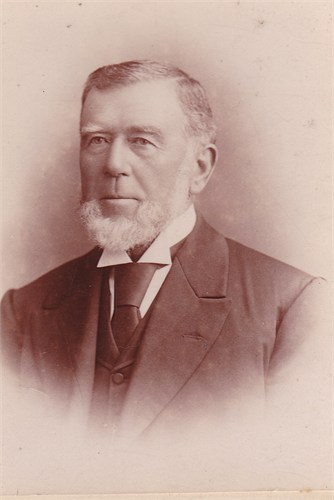
James Chisholm was one of those caught up in the tide of enthusiasm whipped up in the mother-land by Captain Francis Grosse who was putting together a regiment to maintain law and order in the new colony. Chisholm enlisted as a Sergeant in England in July 1790 and sailed on the 'Britannia' in the Third Fleet arriving in the fledgling colony in March 1791. He was discharged from the NSW Corps in February 1810. By then he had married Mary Brown, who bore him a son, James, in 1806. However, by then James Snr was set up for life. With his commission came the pledge of a grant of 60 acres of land. And he selected his grant at what is now the Eveleigh Goods Yards. However, his wife, Mary, departed this life in December 1817. Their son, James Jnr, pictured went on to begat 9 children, all but one living well into adulthood. James Snr died in 1837 and was interred here with his first wife. Looking at the dates, Mary had been re-interred into the Devonshire Sandhills Cemetery in 1820, and they were both re-interred into Camperdown when Devonshire was converted into Central Station in 1901. Tough journey.

However, with its compensations. For James Snr, at least. On his grant of 60 acres, he built Calder House (named after the village in Scotland from whence he, too, came), pictured here. So, even economic refugees add value.


This is my contribution to the Taphophile Tragics community.

Tuesday, 3 July 2012

Taphophile Tragics - an addiction

Every so often th e plot number is chiselled into the concrete foundations of the tombstone.

I first met Emily Amelia Puckeridge on 22nd May this year. "Met" is probably stretching it; became aware of her existence is more like it. I have, you see, a "bucket list". And on that list is the aim of completing my family tree of deceased ancestors. And my starting point has been to try to trace all the lines of my tree back to the United Kingdom. It all becomes a smidge tenuous much earlier than that, I justified to myself. I took the Cole line back past its arrival in Melbourne in 1860. I traced the Tonkin line back past its disembarkation in Melbourne in 1857. I knew that my maternal grandmother had emigrated from Wales to Sydney as a war-bride in 1920. So, just one line to go: the Selby line.

This bunch of lily fronds grow above Amelia's last resting place. Using the Rookwood Deceased Search, I proved the plot next door for John Mangnall was plot 1040

Using a combination of Ancestry.com, the NSW Births, Deaths & Marriages, and the Rookwood Deceased Search I drilled down into my grandfather's past. His mother had died in childbirth in 1904, when Cecil Roy was 6, his father, John William, dying in 1939. But what of his parents? Well Thomas James Selby died in 1917, with his wife, Mary Ann, dying in 1921. Thomas James arrived with his parents and older brother in 1839 on the "Spartan" under the Bounty Migration Scheme. Tick off another one.

How about Mary Ann? She was born a Puckeridge in 1839 in Sydney to Richard and his wife Emily Amelia. So down further I drill. Pretty soon, I discover that Richard was born in Sydney in 1812. My heart did a flutter! Born in Sydney in 1812! Something similar with (Emily) Amelia, his wife. Born in Sydney in 1815! Bloody hell, methinks. Am I stumbling onto something here? If these two were born THAT early on in the life of the new colony (born during the governorship of Lachlan Macquarie) how did THEIR parents get to Sydney?

Richard Puckeridge's father, Joseph, was sentenced to 7 years transportation to the colony in 1801. His wife, Ann Maund, accompanied him, but their two young children perished on the journey. A convict! Yeehah! I have convict ancestry.

But what of Amelia? She was born in 1815 to Susannah Smith who had been transported to Sydney for 14 years penal servitude in 1812, arriving on the "Wanstead" in 1813. Heavens to Betsy! Another one!

And Amelia's father? He was one Thomas Hughes sentenced to 7 years for theft, arriving on the 'Surprize" in 1789. Could I believe what was unfolding before my eyes? A third convict ancestor, and this time one who came over on The Second Fleet. Be still my heart ...

The map from the Anglican Trust proved essential. Section G is down the bottom extreme left.

So, may I introduce to you (Emily) Amelia Puckeridge (nee Hughes) born in 1815, who died in 1895. My great-great-great-grandmother. Who resides in the Old Anglican area of Rookwood Necropolis in Section G, plot 1041. No tombstone, but I rarely expect one now that I am more savvy. Penury runs in our genes. Penury, and a certain disdain for the religious sensibility.

Left: the plot for the Mangnall family was a double check.
Amelia Puckeridge. The photo is undated, however, there is also one of her husband, Richard, and he died in 1881 aged 69. In 1881 Amelia would have been 66 years of age.


This is my contribution to the Taphophile Tragics community.

Tuesday, 19 June 2012

Taphophile Tragics - A face in the gutter

This weekend just past, was the anniversary of Bloom's Day, that extraordinary 16th June 1904, described by James Joyce in 'Ulysses' where Joyce follows his hero, Leopold Bloom, around Dublin. I did not see any coverage of this at all in my own city. Usually I do, but just not this year.

Nor did I see any coverage of the 145th anniversary of the birth of Australia's own, Henry Lawson. But I expected this. Whereas the United States lauds the likes of Walt Whitman and Mark Twain, Australians cringe at the achievements of the likes of Lawson, and Banjo Paterson.

Left: Henry in 1881 aged 14; Right: Lawson in 1888 aged 21
Lawson was a sad, melancholic man, an alcoholic who was in and out of Darlinghurst gaol because his wife, Bertha, needed to be constantly at him for child support. How that helped is lost on me. Lawson wrote of the NSW countryside as he visited the rivers and lands west of the divide. But, in reality, he was a man of the city, of the industrialised inner-city where, even today, drunks and other addicts people the streets and the gutters.

Left: Henry in 1893 aged 26; Right: Lawson in 1910 aged 43
Lawson died in a tawdry boarding house in Abbotsford in the inner west of Sydney one bleak September day in 1922, aged just 55. He had been sitting up in bed writing with his stubby pencil, as was his want. He complained of discomfort, but upon attendance his doctor diagnosed nowt. An hour later, Lawson lay dead in a corner.

Of course, all and sundry wanted the glory of a funeral, but no-one wanted to pay for one. Eventually, the Prime Minister, Billy Hughes (similar in character to Lawson), agreed to a State Funeral, and made sure another tier of government paid for it. And I quote from Colin Roderick's biography:
Lawson's funeral took place on Monday 4th September. Throughout the morning, his open casket lay in the mortuary chapel (Wood Coffill at Camperdown), where hundreds of his friends filed past to take a last look at his face. Shortly after noon, the casket was taken to St Andrew's Cathedral,. On it was placed a bunch of native roses, and around them a spray of gum leaves, a cluster of golden wattle, and bush ferns. Magnificent wreaths lined the choir stalls and the alter rails. A score of Lawson's relations had materialised from beyond the horizon of his life. He was buried in Waverley Cemetery. And thirty five years later - in a final act of sentimental irony - Bertha's ashes went into the same grave.
This is my contribution to the Taphophile Tragics community.

Tuesday, 12 June 2012

Taphophile Tragics - My kingdom for a monument

Hunching my back beneath a brolly, I wove my way through Kew Cemetery, a jam-packed cemetery, yet respectable and middle-class, a touch old school, of sardines and cement.

With the coordinates scratched on a scrap of paper crunched into my coat pocket,I was aching for a headstone, a monument provided certainty. The previous day at Springvale Botannical Cemetery, I had located resting places for the two sisters of my great-grandfather, Charles Wilkins Cole, but they lay beneath turf, minus any headstone, any message from the past.

One of my jobbies whilst in Melbourne, was to record for my family tree, these last resting places. Now, following a totally different ancestral line, I tried to make reality fit the diagram. I was searching for the eternal resting place of my great-great-grandfather, John Dunstan Tonkin (1912), and my great-great-grandmother, Jane Forrest Gibson Tonkin (1899). They were here somewhere.

Some plots were mossy, some rugged. Some numbered, some not. Here was 669, so 888 and 889 could not be far away.

Using my trusty walking stick, I gingerly negotiated a 180 turn ... and there it was ... T.O.N.K.I.N ... right before me. Solid. Grey. Granite. Respectable. Named. Befitting an iron-monger.

My friend was as chuffed as I, and our joint whoops and hollers were fit to wake the dead. Almost. The two plots were within the one memorial, raised up and defined by a wrought-iron fence. JDT and JFGT, two infants (William 3 months and Percival 3 weeks), and one young adult, George aged 24 years. Plus their faithful daughter, Jane, who kept and cared for them, and joined them in 1930 aged 75.

I will transcribe the weathered inscription, and faithfully add the details to my tree. I will share the images, and the exact location, with cousins. And, when I visit Melbourne next, I shall have gained permission to plant the grave with perennials.

Some colour, and my own warm touch upon cold, hard stone.

This is my contribution to the Taphophile Tragics community.

Monday, 16 April 2012

Taphophile Tragics # 17 - Trumpeting the way to life everlasting


Many people die in the hope of resurrection. Today, I show you a sublime example of the Resurrection Angel, holding a trumpet and pointing the way to God and Life Everlasting. It was commissioned by a loving (and rich) son, in memory and hope for his parents.
Although 'reserved and retiring', he was a 'very kindly gentleman', with neatly brushed hair and a trim beard and moustache. He was a member of Killara Golf Club, and was an excellent photographer.
Thus goes the entry in the Australian Dictionary of Biography for Sir William Dixson, after whom the Dixson Wing of the State Library of New South Wales is named. I will refer to him as Sir William, not in deference to the imperial Honours System, but because this monument gives no greater emphasis to him than to any other member of his very large family. The Dixson Wing comprises a gallery, and a library. The Dixson Gallery was opened in 1929 and the Dixson Library, housing Sir William’s great collections of rare books and manuscripts, coins and stamps was opened in 1959, seven years after his death. In the 1930s, Sir William gave to the library its great bronze entrance doors, and three stained-glass windows in the main reading room.

Sir William himself was a bachelor who was buried with Anglican rites, whereas others in the family were cremated with Presbyterian forms.

This is actually the monument of his father, Sir Hugh, but I don’t want to talk about him because he started the family fortune from tobacco. But, to their credit, it was what they DID with the fortune that was interesting. Sir Hugh and his wife, Dame Emma (*groan* those honours again!), were philanthropists of a religious and uplifting bent. They had six sons, and four daughters. Four of the sons predeceased them, their youngest, Thomas Storie, was a Lieutenant in the Coldstream Guards who perished at Amiens in 1916.

But it is the reserved and retiring Sir William, who has left his mark on our city.


This is my contribution to the Taphophile Tragics community.

Tuesday, 10 April 2012

Taphophile Tragics # 16 - No hard feelings


No image of the inscription on this marker, it is too hard to read. However, look at the symbol his family and friends chose. It is a Sydney tramways car.

This gravestone is in the old Presbyterian section of Rookwood Cemetery, and celebrates the life of James Ross Logan, born in Scotland in 1841, died in Sydney in 1890, aged 48 years. He was a tram driver, and was trundling along Botany Road, Botany when his tram rolled with him underneath. Not sure about you, but under these circumstances, I would think twice about putting a tram motif on his headstone!

Argh!! You all stung me into action. So into Trove I went and found the gruesome details. I had to chuckle as each witness had their own pet theory as to the cause. Things have not changed much down through the years! Use the slide-bar down the bottom RH corner to increase the size of the font. I have also included two photographs of this model of tram which I believe is a DD. I will get my expert Mr Casperson to check for me. Anyways, the above two images are about that era, maybe 1885. The first image shows Tram No. 23. The second image is too dark to read the number, but was taken at the intersection of Market & Elizabeth Streets where Hermes now stands (opposite DJs and near St James Station). The building on the right is the old Albion Hotel.


James Ross Logan was from Renfrewshire in Scotland, where he married Margaret Thomson in 1862. There were already three children of the union - James, Alexander, and Agnes - when James and Margaret emigrated to Australia on the Wansfell in December 1863. James was 22 and Margaret 24. They were to have another 8 children, two of whom died in infancy - Isabella in 1872, and John Ross in 1874. They could be interred with their father. They are most certainly named on his gravestone.

When James Ross Logan died beneath his tram in 1890, Margaret was aged 51 with 9 children ranging from 32 year old James, to 9 year old Margaret. My guess is that the tramways union assisted with funding for the erection of this monument. Margaret died in Marrickville in 1915 aged 76. Her youngest daughter lived until 1967.


This is my contribution to the Taphophile Tragics community.

Tuesday, 3 April 2012

Taphophile Tragics # 15 - How to win at Scrabble

THE PORTAL IS BACK! GO READ ...


I adore scrabble, but am always being slaughtered at it. So, I perked up when the guide on the Heritage Walk through Rookwood Cemetery on Saturday pointed out the instrument on the marker above, the one that looks like a speech bubble in a comic. It is, in fact, a 'zax' (plural zaxes), which is an instrument used by slaters (a chap who works on your roof, dearie, not a sluggish thing under a rock in your garden) for cutting and dressing slates; a kind of hatchet with a sharp point on the pole for perforating the slate to receive the nail or pin. There is a striking tool above it.

So, I gathered that herewithin lay a slater. Well may you say 'under a rock in a garden' ...


But, then I looked more closely. One son (the fifth) dead by accident in 1912. Another son (the youngest) dead as a casualty of war in 1917. Before WW1 John Gordon Lorimer died when his motor-bicycle collided with a tramways car. John was born in 1887, four years after his parents, and his five older siblings immigrated to the colony of NSW on the 'Ellora' from Scotland. David was a slater & plumber. Ann had her hands full with an 11 yo daughter, Jessie, and four younger sons. Jessie was born when Ann was 18 and David only 21.


And. then, in 1887, Wallace Hepburn Lorimer was born. The grave marker states he was a sergeant in the 1st Imperial Camel Corps, who died in the Gaza. His record of service states:
Killed in action in the advance to, and while in temporary occupation of, a Turkish redoubt and owing to the position being vacated and not subsequently re-occupied, the dead were not able to be buried.
The two letters included here are from the record of service of Wallace Lorimer. Both letters were written by his father, David. BTW, when he enlisted in 1915, Wallace described himself as a slater. That may account for the details on David's letterhead. There are only 5 years between the writing of the two letters, ageing David from 66 to 71. It looks a lot more than that. He has aged and gone creaky very quickly. It is clear from the file, that what I typed above was all they ever found out about the skirmish in which their youngest child perished. David writes, pleading for information 'you have a sorrowing father's feelings that you may be able to ease the pain a little'. But no response to this is held on file. David did understand that there was a war on. But the sorrow took its toll.


In the second letter, David, is trying to find out if his son's Next-of-Kin qualify for a medal, and whether there is a form to be completed. Well, yes, he did qualify. he served overseas. And he died overseas. No body for burial, just a memorial plaque at the Jerusalem Memorial in Israel. And the government sent his NoK a 1914-15 Star, a British War Medal, a Victory Medal, a Memorial Scroll, and a Memorial Plaque. Together with a plaque in the Garden of Remembrance at Rookwood.

I wonder if all that 'eased a sorrowing father's feelings?


This is my contribution to the Taphophile Tragics community.

Tuesday, 27 March 2012

Taphophile Tragics # 14 -From the Demon-drink to Eternity


Up to 50 times a day he wrote it: the word ‘Eternity’, in waterproof chalk, in a flowing Copperplate hand. Fifty times per day for 35 years, is a powerful message. Upwards of half a million examples, and it is typical that the one original supposed to still exist is difficult to prove. You see, it is inside the bell within the Martin Place GPO clock tower. Taken down as a precaution during WW2, the bell was cleaned and replaced in the 1960s, and THAT is when it was discovered that Stace had been there. There are two replicas: the one on the foot of his grave in Botany Cemetery, and the one beside the Cascade, within the NY Metro Cafe in the Town Hall Arcade.

What drove Arthur Stace to a life on the streets?
Poverty. Alcohol. WW1. Self-image. Finding God.
That would pretty much do it.


He was born in Redfern, lived most of his life in Bulwarra Road, Pyrmont, and died in the Hammondville Nursing Home out at Liverpool. Pretty much a flat-lined activity. He served in WW1, probably as a stretcher bearer, where, upon enlistment, his vital statistics indicated he was ‘weedy’. He hit the skids upon being demobbed, and in a highly impressionable state, came within the orbit of a fire’n’brimstone pastor at either St Barnabas’ Broadway, or the Burton Street Baptist Tabernacle in about 1930, in his mid-40s. He did not marry until he was 58.

There are four authenticated photographs of Stace in existence, all taken by Trevor Dallen from the old Sydney Sun. Stace was hard to track down, shunned publicity, and was, effectively, defacing public property. Dallen pinned him down for an interview, but after four shots, ran out of film. Of course, when he returned with more, Stace had etherised – again.


The year 2000 was shaping as massive for Sydney, what with the Olympics and all. The Y2K bug was going to shut down life as we knew it. Sydney’s NYE fireworks featured Stace’s copperplate trademark, this time writ large for all the world to see.

I hope he found it.


This is my contribution to the Taphophile Tragics community.

Tuesday, 20 March 2012

Taphophile Tragics # 13 - Sleeping like an Angel


Anastasios was not quite four years of age when he slipped off this mortal coil. His father 35. It took his father, Dimitrios, another 40 years to join his son. Look at the photograph of the young lad. The apple of everyones' eye, no doubt. Well cared for, religious, middle class, from a close, loving family. Devastation all round. Son, brother, nephew, and uncle already. But all categories of families are devastaed when a child dies. What sets this family apart is that they had the income to attempt to put their tender mourning into art.


For me the eye-catching element of this marker is the prone angel. Eye-catching literally. I was stomping out the rows going down a rather steep incline with a rough path beneath my feet. Out of the corner of my eye I caught this sheen of whiteness and was stopped in my tracks.


Although this is Section 15 General in Botany Cemetery, it is rife with the memorials to departed Greeks. It seems to me, that Botany is riddled with departed Greeks, with as many Greeks as there are Anglos. Maybe the Greek markers are just more obvious. This black style is replcated in many other rows and sections. The Greeks however, are obliged to tend to their departed on a regular basis. And one of their methods is to leave copious flowers. So maybe I am simply seeing more Greek markers because they are tended more assiduously.


There is no initials on this marker. No Mason company. No number. No nothing. Next time I am there, I will ask at the office if his sort of information is held in their system.


This is my contribution to the Taphophile Tragics community.

Tuesday, 13 March 2012

Taphophile Tragics # 12 - The Isle of the Dead


In September 2009, I spent two days walking the ruins of Port Arthur and reading every sign and listening to every audio. I was mesmerised. I am not usually one for being glued to headphones and traipsing meekly behind a tour guide, but just this once I relented, and took the ferry out to The Isle of the Dead. I have book-ended this 'In Memoriam' with two shots of 'the penitentiary', the public face of the penal settlement. This opening image is from within the penitentiary, looking across to the wharf from which the ferry departed. The final image is the scene from the ferry as we returned from our sojourn on the island.


William Mansfield, died 28th February 1858, aged 32 years.


Port Arthur is at the end of the earth. It must have felt like that in 1830, as it still feels like that today. See this rugged coastline. It winds down and down and down ... past the furthest point you can see. Past your own imagining. This is where you were sent as further punishment if you stole a loaf of bread, were sentenced to transportation, and became recalcitrant. They would teach you your place!


The Revd George Eastman, for 26 years the faithful chaplin of Tasman's Peninsula and at other institutions, died 25th April 1870, aged 51 years.

Benjamin Horne, Esq., Headmaster, School Point Puer, died 27 December 1843, aged 33 years. Sincerely regretted by all who knew him.


It is a small island, just a couple of hundred metres off the settlement, but surrounded by the Southern Ocean and its roaring gales, or the impenetrable bush of southern Van Diemen's Land, as Tasmania was known for many years. It was used as a burial ground, and retains that sole purpose to this day. Between 1833 and 1877 approximately one thousand souls were laid to rest here. As you can imagine, a reverential hush descends upon even garrulous tourists, the instant they step onto the island, a reverence for human endurance under the most trying of hells-on-earth.

Social distinctions were observed, and the free were interred in the north-western corner. Several memorials are still evident in this section, but most of the island is bare of headstones as it was forbidden for markers to be placed on convict graves. With one thousand sites on such a small island, no matter where you tread is sacred ground.


In memory of Ann, wife of Michael Gibbons of 21st Royal North British Fusiliers, died 20th June 1838, aged 27 years. Leaving an affectionate husband and two children to lament her loss.

Private Robert Young, 51st King's Own Light Infantry, who was accidently drowned at Port Arthur in the performance of his military duties, 9th March 1840, aged 20 years. This stone was erected by his comrades as a memorial of their respect and esteem.


And so we return, leaving this isle of sorrowing dead to their bleak eternity.

This is my contribution to the Taphophile Tragics community.