Showing posts with label Lachlan Macquarie. Show all posts

Friday, 25 September 2015

The Macquaries were "greenies" ...


To my way of thinking, this pair left an indelible mark upom the structure, and the style, of Sydney. They lodged at the first government house from 1810-1821. He reorganised the layout of the streets, no mean feat considering the topography with which Sydney is blessed. And yes, he named one of them Macquarie, and another Elizabeth.


He confirmed Hyde Park as a leisure ground for the peopke, and set aside bothThe Domain, and the botanic gardens.

She, by her perambulations, set in concrete the road from Bridge Street to the point named after her. She also was heavily involved with both the orphans home, and the female factory out at Parramatta.

Given the social structures of their time, they wee progressives, who gave transgressors another chance after they served their time.

Wednesday, 25 March 2015

Hyde Park - St Marys Cathedral then


What we have in Sydney today, IMO the grandest church in our City, is the third attempt to construct a home for the city's catholic faithful. Although Australia was conquered, and settled, by Britain in 1788, the foundation stone for the first catholic church was not laid until 1821. Britain was wary of the catholics in the First Fleet as they were overwhelmingly Irish, and had been sent to the ends of the earth for political insurrections. For the first 25 years of the colony, catholics met covertly.

Left: Sketch by John Rae, 1840 Right: Sketch by John Rae (1840-1850
Both inages courtesy Dictionary of Sydney

Governor Lachlan Macquarie laid the foundation stone for the first St Marys, in October 1821. This was on the same site as the current Cathedral. It ran east-to-west (whereas the current cathedral runs north-to-south). At the same time, Macquarie was involved with the Anglicans. The Church of England was the "established" church and had a life of its own in the colony. However, its cathedral (St Andrews) got off to a spluttery start, with the first foundation stone laid in 1819, the second in 1837, before being consecrated in 1868.

Left: After the fire Right: After the fire, c. 1870
Both images courtesy Dictionary of Sydney


After a range of alterations, this Macquarie-inspired catholic cathedral was badly-damaged by fire in November, 1865. They rebuilt in stages, with the first service being held in 1882, with more construction work being completed in 1900, 1928, and even as recently as 2000, when the two spires in the original plans, were added. Embiggen the old image on the left to see, that even then, those with drug-addictions made their home in Hyde Park.

There is only a miniscule portion remaining of the cathedral that burnt. This is around the back (east) of the cathedral but easily accessible by the public. There is a plaque on this ruin which reads:
This pillar is all that remains of the original St Mary's Chapel, the Foundation Stone of which was laid by Governor Lachlan Macquarie on 29 October, 1821. Father John Joseph Therry celebrated the first Mass in the partly completed chapel on 5 December, 1833.


This is the southern forecourt of St Marys. It used to be a lawn bowling club at which my father played. It is now a concrete park with a swimming pool and fitness centre below. At my back as I took this phtotgraph is The Australian Museum, which I will cover next week.


Tuesday, 1 June 2010

... and our fathers that begat us ...

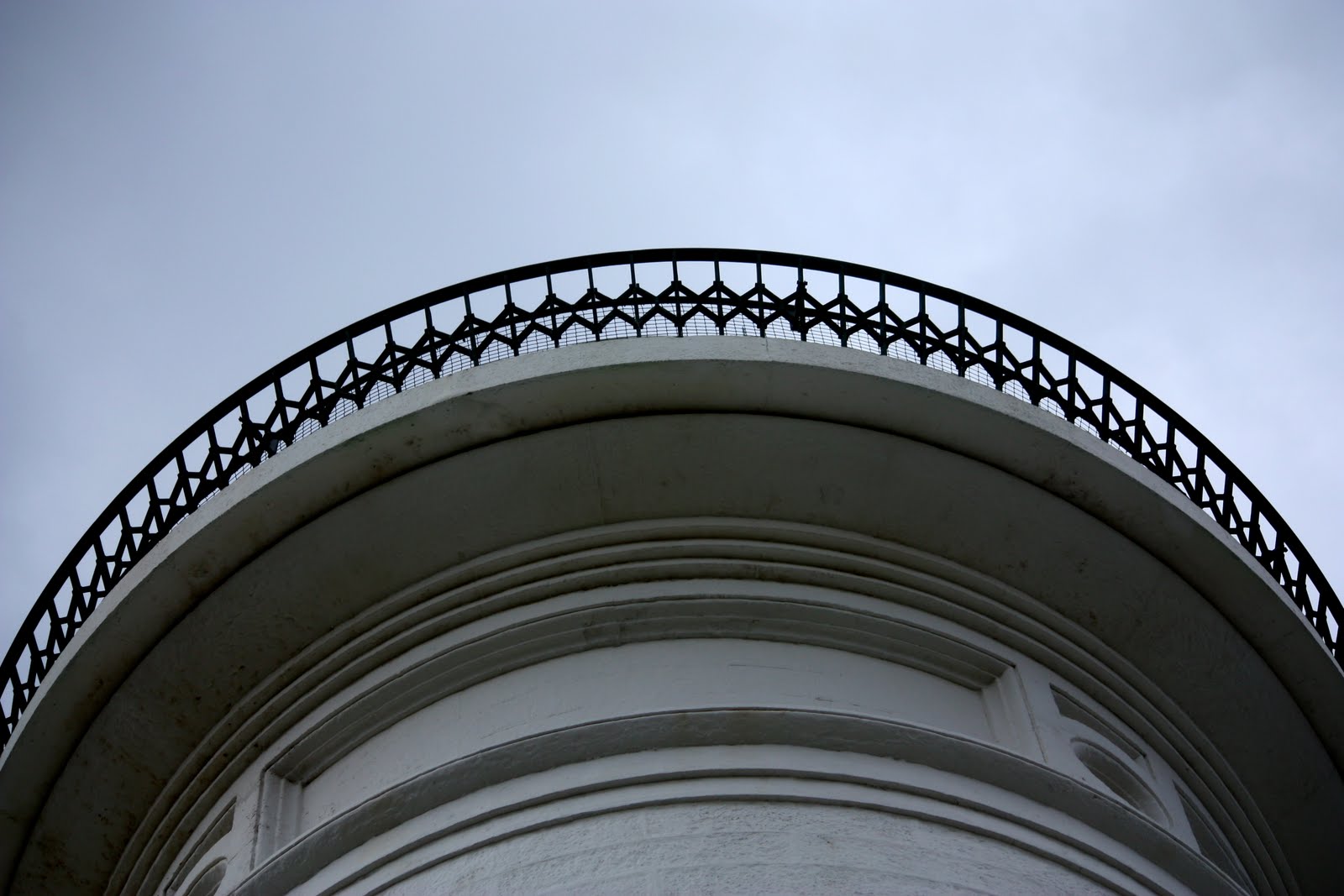
The balcony of the second incarnation of Macquarie Lighthouse which replaced the original in the 1880s
Eight of us oldie-nutters have spent a day a week for the last month walking in the footsteps of Governor Lachlan Macquarie who governed this colony from 1810 until recalled to 'answer questions' in 1822. For our final walk, we caught a ferry out to Watsons Bay and tried to envisage the harbour as it looked to the early settlers.


Macquarie was the first 'army' Governor and had to clean up a bit of a social mess. He got a few noses out of joint by treating all men equal once they had served their time. He utilised any known skills whether the person was male or female, convict, emancipist or exclusive. This got him off-side with some powerful people (read John MacArthur).


To clean up the mess left by the NSW Regiment who 'marched' on rum, Macquarie brought out his own 73rd Regiment of Foot. To my embarrassment, I have walked past this monument sooo many times. It's the original obelisk placed there in 1811, when the 73rd finished the track from town out to the South Head Signal Station. In 1814 Macquarie got his convict architect, Francis Greenway, to design him a gracious light-house to serve the colony from South Head.

We owe these two blokes heaps.