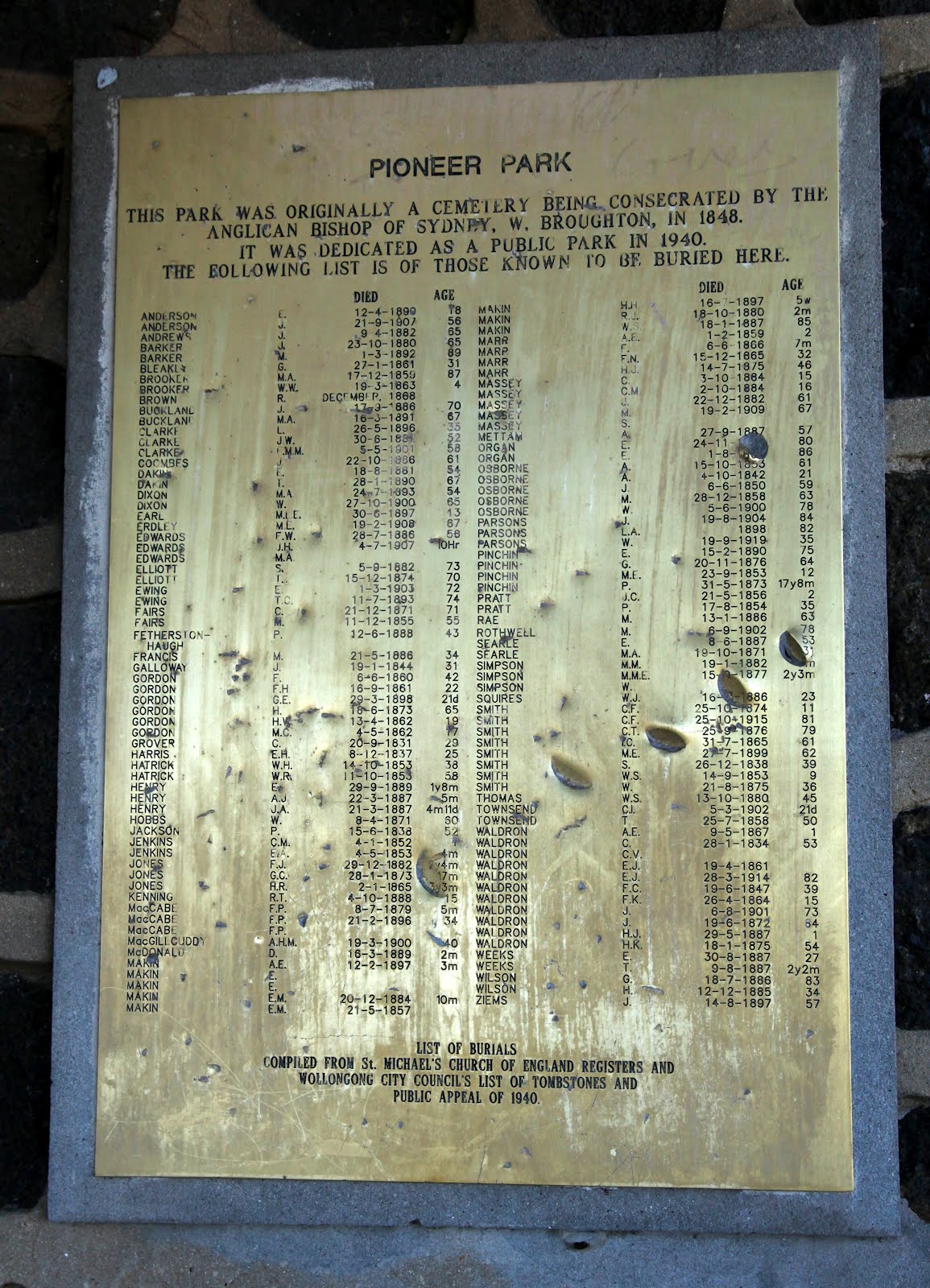
| This brass plate is inside the entry porch. Mary is buried under her married name. She is the oldest person buried there, but by no means the earliest. |
Childhood changed dramatically during the 19th century. And it would want to! Take these two singular experiences of childhood.
John Hudson was the youngest male on the First Fleet of 1788. Indeed, when he was found guilty at the Old Bailey of breaking, entering, and stealing in October 1793, he was 9 years of age. initially destined for America on the 'Mercury' he was caught up in the mutiny on that transport in the first half of 1784, recaptured and sent to the Dunkirk hulk later the same year. In 1787 (three years later! three years in a hulk) his name was listed on the 'Friendship', one of the ships of the First Fleet. Friendship! Oh, death where is thy sting! The first few years of the new settlement were touch and go, with failed crops and non-arrival of supply ships. So in March 1790, John Hudson was one of the misfortunate ones to be transported further - to Norfolk Island. Would that it were the gallows. A year later Hudson, aged 17, endured 50 lashes for being outside his hut after hours. He is then lost to history.
The industrialisation of the English midlands, the enclosures, the evangelicals, Victoria's reign, the various Factory Acts, and, yes, even Charles Dickens,led to the period of life from birth to about 14, being regarded as sacred. At least in the Western 'developed' countries.
| I am not convinced by either of these supposed portraits of Mary Wade Brooker, but who am I to know. I unearthed them on Ancestry.com without having found a reliable source for her life story. Mary led a tough life. She would be more battered around than either of these portraits reveal. |
The youngest female convict, Mary Wade, was transported on the 'Lady Juliana' in 1790. She was tried in January 1789 at the Old Bailey on charges of 'feloniously assaulting an 8 year old girl and taking a cotton frock, a linen tippet, and a linen cap. Value 3/4d. Wade was 10 years old. Her death sentence was commuted to transportation for life. The 'Lady Juliana' left for the colony with 244 female convicts on board. According to the journals of the steward, John, Nicol, 'When we were fairly out to sea, every man on board took a wife from among the convicts; they nothing loath'. There were 51 girls under the age of 19 on board.
| The unpreposessing entry to 'Pioneer Park, Wollongong. The Civic Fathers must not know the gems buried within. |
Mary spent a number of years on Norfolk Island, returning to the mainland in 1806 with an indeterminate number of children. She married a John Brooker not long after her return, and bore 21 children in total. She died in Fairy Meadow in 1865, and was interred in the St Michael's churchyard on the corner of Kembla and Banks Street in Wollongong. At the time of her death, it was estimated that her descendents numbered in excess of 300 persons. Her descendents now number in the thousands, one of whom is our previous Prime Minister.
St Michael's churchyard went to rack and ruin during the first half of the 20th century, the final interment having occurred in 1919; the first in 1838. The state government of the day, went through the process of converting the graveyard to a public park. None of the deceased nor headstones was removed. The headstones were lain down flat above the remains, and tonnes of rubble and soil moulded the surface into a neat and tidy public park, with roses, salvia, primula, and English Box hedges.
So what value a childhood?
| The park is scattered with an inordinate number of bright yellow taps, a sure clue that it was a graveyard in a previous incarnation. |