Showing posts with label The Rocks. Show all posts

Tuesday, 4 August 2015

Freehills Bakery - the restoration


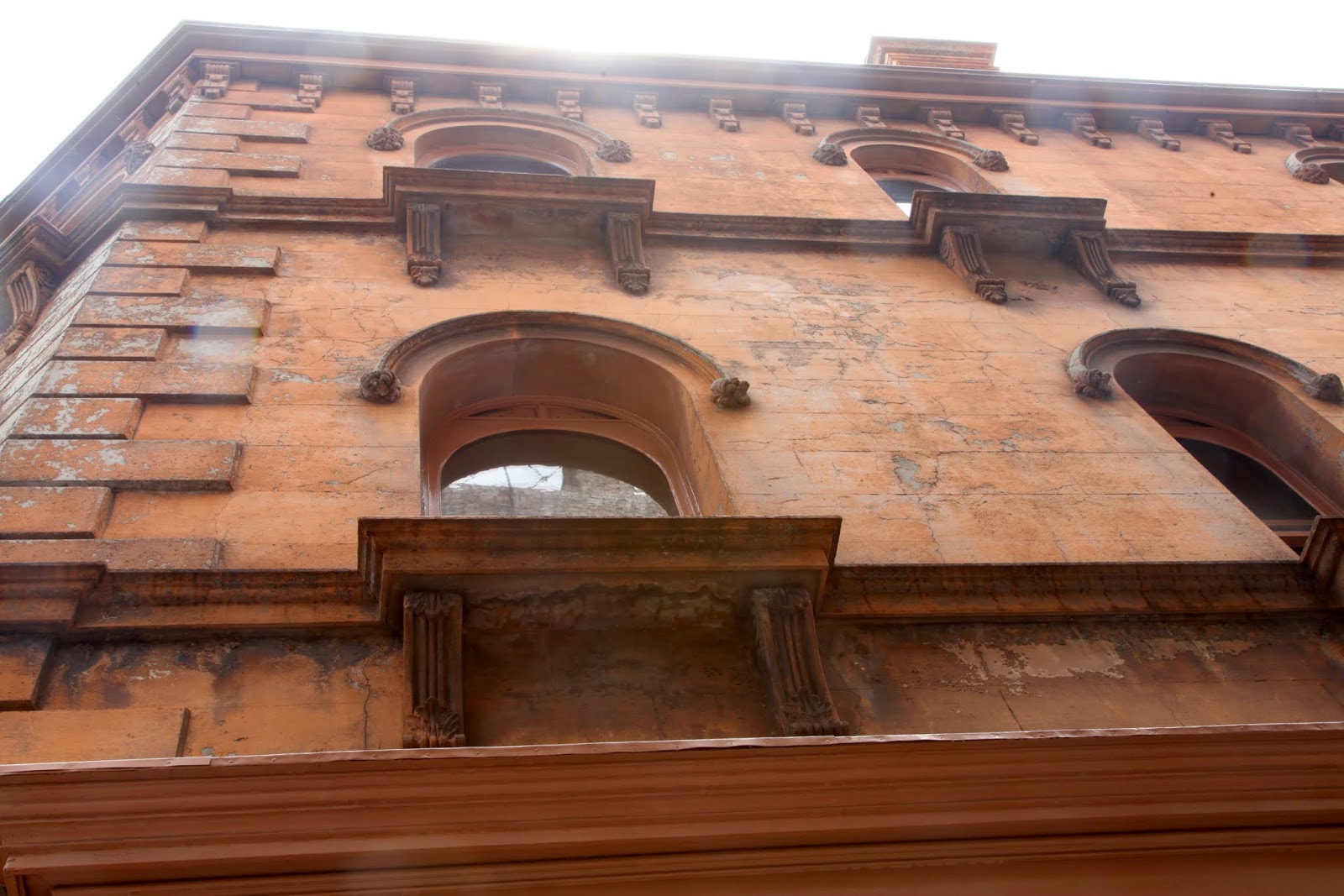
This is 107-109 George Street North, The Rocks. It was constructed by Patrick Freehills in 1860 as a bakery. Pretty soon thereafter it became a pub, "The Shipwright's Arms". It kept on changing identity, as it slunk into decrepitude. In the 1980s it was restored by the chef, Neil Perry, as his Rockpool Restaurant. It is now "William Blue Dining". Billy Blue was the coloured puntman who plied his vessel from Sydney Cove over to Milson's Point in the first half of the 19th Century. He was one of a sprinkling of Africans who came to Australia in the First Fleet.


Those two images above show how the building looked in the 1970s, prior to restoration.

Note the parapet. Well, I think it is a parapet. It is in the restored building, but not in the delapidated one. The name and date are in both, but the hospitality pineapple has been restored.


Saturday, 4 April 2015

Logoi - Sydney Youth Orchestras


Such a vibrant logo which perfectly describes the vibrant energy of music-making youngsters.

I chanced upon their administrative HQ, as I wandered back along Cumberland Street in The Rocks, after the photo-making for my post of yesterday, about the Argyle Cut.

IU am not sure of the plural of "logo". It could be "logo", or "logos", or "logoi", or even "logi".

Friday, 3 April 2015

The Rocks - Argyle Cut

Note: I made the four large images in March 2015. The smaller, historic shots are courtesy NSW State Records.

Left: The 1832 architect's plan;
Right: A sketch by S.T. Gill when the bridges were timber c. 1859-60

A steep, rocky ridge ran along the western peninsula of Sydney Cove, known then, and now, as The Rocks. Much commerce was carried on between the citizens of Sydney Cove, The Rocks, Millers Point, and Darling Harbour, and an easier method of transport was essential. In March 1832 architectural plans were drawn up for a cutting, or tunnel. On 9 August 1832 requests from interested contractors were called for via an advertisement in the Sydney Gazette (p. 4).

Left: The cutting in the 1870s
Right: The cutting in 1900

The "Argyle Street Company" could offer 15 engineers, and 30 labourers (convicts). Of course, hand-tools like picks and shovels were never going to be adequate to hew out this quantity of sandstone, and the contract lapsed until 1843, when a second attempt reduced the ridge somewhat but the "floor" was nowhere near level enough for carts to travel. Finally, in 1859, the Sydney Municipal Council progressed with the "cut" and followed with the overhead bridges for Gloucester Street in 1862, Cumberland Street in 1864 and the Princes Street in 1867-68.

Left: Demolishing the Argyle Cut arch in August 1931 to accommodate the Bradfield Hwy approaches to the Harbour Bridge;
Right: The job nearly completed. Note the watching crowd in the distance. They are standing beside the Garrison Church.

The cutting and associated bridges lasted from the late 1860s until the early years of the twentieth century when the configuration was again changed as a result of the razing of significent sections of both Millers Point AND The Rocks in a valiant attempt by the Sydney Harbour Trust to combat an outbreak of the plague.

Within 25 years, the area underwent even more substantial change when streets, houses, and gradients were all substantially altered to accommodate the behemoth that was the Sydney Harbour Bridge.


Sydney Harbour Foreshore Authority, Heritage and Design Team : Conservation Management Strategy for Argyle Cut And Argyle Bridge (2009)

This is an 82 page government document that contains a wealth of information about the Argyle Cut, together with a trove of historic images, and maps.

Monday, 19 January 2015

2. What would I miss? Sydney's history ...

Corner of Cambridge St and Argyle St, from the overhead bridge on Cumberland St.


In my first riff upom our upcoming theme, I posited that I would miss the harbour, and its beaches, the sun and the sand. Steffe Jansson shot back that I could simply move to another seaside city ... mmm ... he is right, y'know.

There must be something else I would miss should I move away from Sydney.

How about the history of places like The Rocks? It sounds a bit over the top to miss history in a city that was only established in 1788. But there are not many world-class cities which were established as a penal colony.

Monday, 29 December 2014

The Rocks - Lilyvale House (Cumberland Street)


The final image is the plaque, which states that the colours are the original ones, reapplied!


Lilyvale Cottage (1845), 176 Cumberland Street, The Rocks

Sunday, 28 December 2014

The Rocks - Sydney Harbour B&B


This is all that remains of a group of working man's terraces built in 1914 by the State Government. They now function as a Bed & Breakfast. As can be seen from the two older images (from SHFA), the area immediately in front of these terraces has changed markedly from the time of their construction. The land was graded down (carved out!) extensively when the approaches to the Sydney Harbour Bridge were constructed from 1928-1932, leaving just a narrow precipitous walkway. The remaining three of the original six terraces, all operate as the one accommodation.

Saturday, 27 December 2014

The Rocks - 138 Cumberland Street


This building could just be seen in the corner of yesterday's "ghost" building (thanks, Joan). It is far from the first building on the corner of Cumberland Street and Long's Lane (originally known as Maori Lane), having been constructed between 1880 and 1882. It has had a speckled history going from drapery, to butchery, to boarding house, to delapidated squat, to recruitment office. According to historian Grace Karskens, Longs Lane in the 1860s was far from sanitary, with seven cramped houses sharing one water tap.

Friday, 26 December 2014

The Rocks - off Long's Lane

Before Christmas interrupted, I was on a meander through The Rocks, which is a small suburb in the oldest part of the city. A lot has been knocked down over time, and even more has been gentrified.

However, the "feel" of its origins - cramped, higgledy-piggledy, impoverished - can still be seen. There are countless laneways, an over-supply of pubs, and numerous squished terraces where the living conditions must have been atrocious, especially if you were down-exposed-drain from others.

Many of the demolished premises have their history exposed, with a number of "digs" occurring at snail's-pace. There is much beauty in these stark reminders.

Friday, 19 December 2014

The Rocks - the hoi polloi

The Rocks is the area to which the convicts were assigned when Sydney was founded in 1788. It was steep, rugged, and barren. The convicts were not locked up, neither night, nor day. Being banish-ed to the end of the world was considered punishment enough.

Today, this area is much sanitised. Not totally bull-dozed, but probably unrecognisable even to folk who lived there in 1900.

Saturday, 11 October 2014

Apropos of time standing still

One of the venues for SAG, the Society of Australian Genealogists, is in Lower Kent Street. I catch the 207 bus from the end of my street, which gets me to York Street outside Wynyard Station. From there I hoof it (avec cane!) through a maze of underground passages and cycle paths (bless Clover Moore's little cotton socks!) over to Kent Street. I have not yet been able to walk past "Cava", without a coffee and croissant, warm but otherwise plain.

Today's course was "Researching and Understanding the Convict Sytem in NSW". Which was quite ironic, as whilst sipping my coffee, I was in The Rocks, where the convicts were tossed in those first turbulent days of the colony.

Saturday, 3 November 2012

Friday, 3 February 2012

Sing out!


On days of great national celebration, you are either a 'this' type of person, or a 'that' type of perso. A 'this' person, sorts through all the events on offer, chooses one thing to participate in, or go see. A 'that' type of person wanders around not wanting to miss out on anything, and hoping that something of note falls into their lap. I guess that is a criticism, right? I am a 'this'.


However, on Australia Day, a friend and I wandered around The Rocks to see what was on and what folk were doing. And we chanced upon something quite wonderful and very entertaining. In The Nurses Walk, just off Suez-Canal, deep in the heart of The Rocks, there was a niche put aside for a continuing ring of choirs to entertain the milling mass. The Sydney Gay & Lesbian Choir was one such choir. It was great to see them flick the switch to vaudeville and really get the crowd onside.

Monday, 23 January 2012

Monday Mural - Harrington Street


The Rocks is a suburb of Sydney settled within weeks of the arrival of The First Fleet. It was named from the high sandstone escarpment that ran along the 'spine' of the western shore of Sydney Cove. Building was tough and rough, and therefore, the suburb was populated by the convicts, thieves and whores who were part of our first settlement. The soldiers and administrators lived along the eastern and southern shore of the cove.


In the late 1920s the geography of The Rocks was decimated (north-south) by bull-dozing required to swathe the approach to the Sydney Harbour Bridge. In the mid 1950s The Rocks was once again sliced (east-west this time) by the construction of the Cahill Expressway extending the railway to the east of the city, and increasing the flow of vehicular traffic onto the bridge.

These murals are on stanchions of the Cahill Expressway as it crosses Harrington Street. They show scenes of The Rocks in its hey-day, prior to the general widening of roads and attempted gentrification of the area at the very beginning of the 20th century.


View Larger Map

This is my contribution to the Monday Mural community.

Thursday, 15 September 2011

Remembering the Forgotten: Brown Bear Lane


In 1848 Joseph Fowles produced a booklet of copper-plate engravings showing the streets of Sydney. The engraving on P. 16 depicts a section of lower George Street showing 'E. Chambers' 'Brown Bear', which was a notorious pub in The Rocks. The pub bequeathed its name to a laneway. This laneway later became Little Essex Street and then was consumed totally during numerous rebuildings of the area.

In 2006 a photograph, in the possession of the Sydney Foreshore Authority, was 'muralized' by Dr Pierre Mol, an art history archaeologist. An article in the University of Sydney Alumni magazine gives the background to Mol's techniques.

Walking down George Street to The Quay, the mural is on the LHS immediately after (nearly under) the railway viaduct. It is incredibly realistic, giving the impression one could wander into it.