Showing posts with label Dr James Fullerton. Show all posts

Wednesday, 15 July 2015

In defence of Dr Fullerton


This is the Fullerton Memorial Church, corner of Crown Street and Albion Street, Surry Hills, in inner-Sydney. It was erected in 1905, using some of the proceeds from the resumption money paid by the state government to the Presbyterian Church when the Pitt Street South church was demolished at the turn of the 20th century, to make way for Central Railway Station. Dr James Fullerton was the first minister of Pitt Street South from 1839 until his death in 1886, very close to 50 years.

I have written two posts recently, which discuss Fullerton's manse, and his church.

Presbyterian Manse, corner Pitt Street and Hay Street, Haymarket
Presbyterian Church, corner Pitt Street and Hay Street, Haymarket

This parish is known as the Chinese Presbyterian Church. The building is the Fullerton Memorial Church. The Chinese Presbyterians made this building their home in 1957.


And just why is Dr James Fullerton (1809-1886) so in need of being defended? Why should I bother with an apologia? I indicated with my previous posts, that I was of the opinion that Fullerton had been "verballed". Once I collected all my evidence - over the last two and a half weeks - it is way too long to present here. So, when it is fully arguable, I will post it on my "Plumbing the Deeps" blog.


Dr Fullerton officiated at the marriage of my great-grandmother, Louisa Chapman, to her first husband, in late September 1874, and a few short weeks later, Louisa gave birth to Ellen, who lived for 10 months. By then this husband had scarpered, and Louisa was married but alone. She could not prove he was dead, nor could she divorce him. My great-grandfather came on the scene, and Louisa lived until 1919, a life of unmarried bliss, but with a gut-wrenching secret at its core. A secret known only to history, and Louisa Chapman and John Bennett Tonkin. Both their Death Certificates said they were married in Melbourne in 1875. This could not be proved by reference to Birth, Deaths & Marriages. I stumbled upon the James Fullerton story when trying to prove a second marriage.

The photo on the right comes from the "Sydney Organ" site.

There is an entry for Dr Fullerton in the Australian Dictionary of Biography, hosted by the Australian National University. It contains some allegations for which I needed to see evidence. Written in 1972, by an Elder of the Presbyterian Church, the entry alleges that Fullerton conducted 400 marriages a year, and that he was criticised by the Registrar-general (of B, D, and M) for running a "marriage shop". That is a lot of marriages a year; and, for how many years did this happen? Both these allegations have been taken, by family history researchers, to be factual, naturally enough. I tried for months to verify these allegations, by accessing newspapers of the period via Trove, without success.

Then I stumbled upon a link between Fullerton and a Dr William Bailey, who boasted in a Supreme Court hearing in November 1872, of conducting 400 marriages a year, provoking the Chief Justice, Alfred Stephens, to label this a "marriage shop". It is more complicated than this, and Fullerton is not lily-white. Neither, is he what has been portrayed, and I think the record should be set straight.

I will set out my case over on "Plumbing the Deeps", and when I am confident, I will apply to the Australian Dictionary of Biography, to have the entry for Dr James Fullerton, examined.

This is the Fullerton Memorial Presbyterian Church when it first opened in July 1905 (NLA).

Tuesday, 7 July 2015

Scots Kirk - Dr Fullerton's Church


Opposite the manse discussed in yesterday's post, is this church, specifically a Presbyterian Church, on the corner of Pitt Street, and Hay Street, in the Haymarket. The third such Presbyterian church established in Sydney Town, by Dr John Dunmore Lang, fire-breathing dragon that he was!


Nowadays, there is absolutely no evidence that a church ever existed on this site. It would have been about where that newspaper kiosk is today, where the exiting tram comes down from the upper concourse of Central Railway station. I cannot pin down an exact date for the demolition of the church, but it was between 1899 and December 1902. The State government of the day resumed everything that stood in the way of the new station, including:
the Benevolent Asylum
the old steam tram depot
a police barracks
the Convent of the Good Shepherd (built on the site of Carters' Barracks)
small domestic terraces
small retail terraces
the Scots Kirk, and
the Devonshire Street Cemetery (aka the Sandhills).


The article from the "Illustrated News" in June 1870 gives a hint that all was not well, and perhaps the manse was being leased, or even sold. By then, Dr Fullerton's family had doubled in number, and he had moved to premises in Elizabeth Street, not all that far away. The old Kerry photographic image on the right (1872) is leading us from George Street, east along Hay Street. I have added text to show both the manse and Fullerton's church.

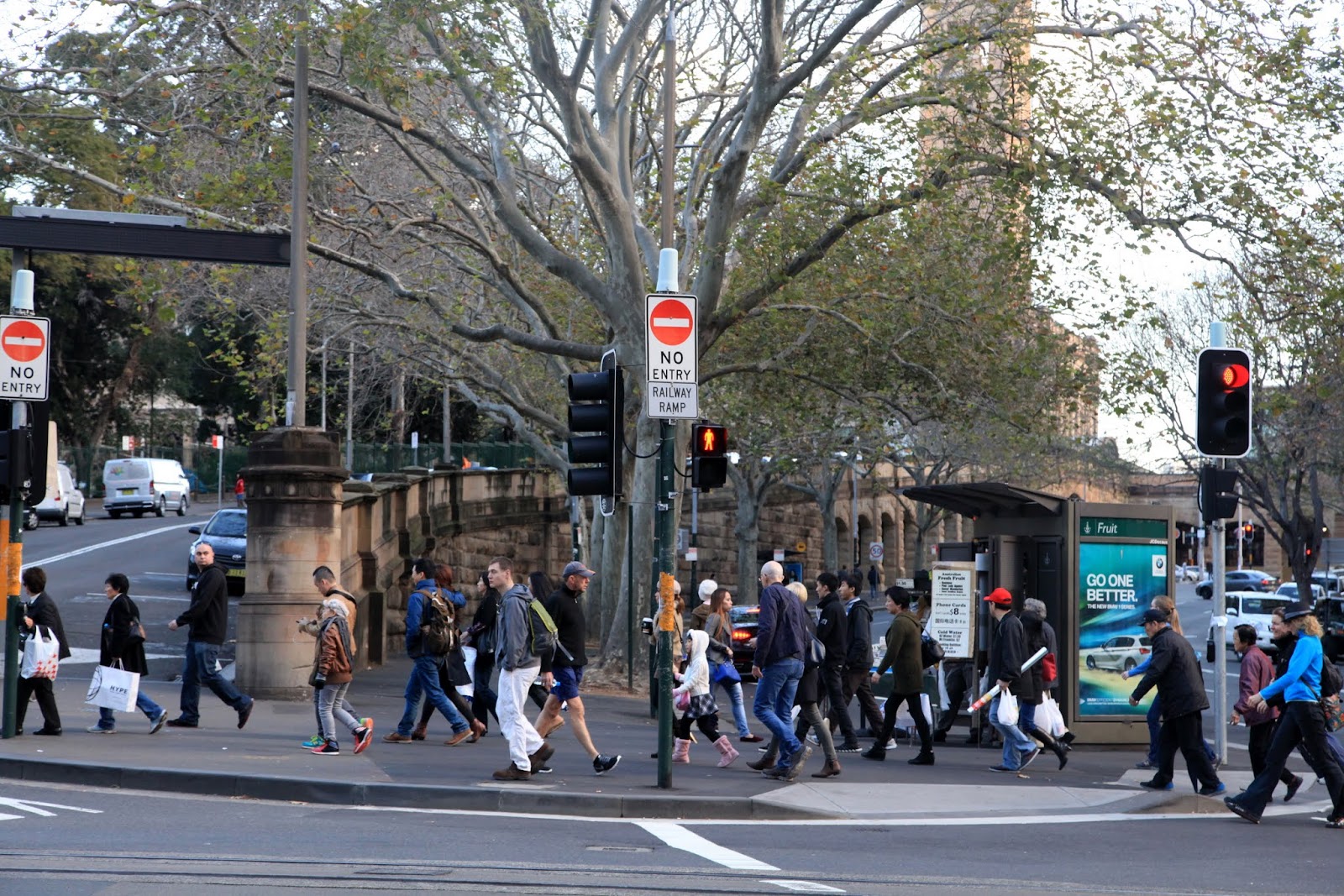
My three shots taken at the end of June, show the disrespect that ignorance engenders. The people scurrying across Pitt St at the lights, and then up the tram exit to the railway, are just going about their business, oblivious to the history beneath their feet. Once, they get up to the rail platform, they will have no idea that the platforms lie atop an old cemetery (1819-1902).

Two more images to give colour to an unglamourous part of my city. An old 1906 shot, looking south along Pitt Street from its intersection with Campbell Street. The railway station was operational, albeit minus its clock-tower, the resumptions, and demolitions, dun'n'dusted. And on the right, my shot looking in the opposite direction, north along Pitt Street from the bend just before Eddy Avenue.

My next post will trace the life and times of Dr James Fullerton. Did he run a "marriage shop", or has he been verballed all these years?

Sunday, 5 July 2015

From Manse to ร้านรังผึ้ง


This building is situated at 461 Pitt Street South, in the suburb of Haymarket. it is on the corner of Pitt and Hat Streets. It was built in 1846, with the minister, Dr James Fullerton, and his young family moving in during 1847.


In May 1986, it had come to this. Just one derelict building in a row of derelict buildings, on the verge of demolition to make way for an office block above a cental shopping mall. The old manse is on the extreme right, with the red awning.


The significance of the site was recognised, and a determination made to preserve at least something. The Wesleyan Chapel and manse were too far gone. The Anthony Hordern building (which I showed the other day) had already burnt to the ground in a spectacular blaze, and the AGL Gas Holders had been dismantled. The entire block was subject to an archaeological review.


By the late 1980s, the manse and the old fire station had been saved, but the other shops in the row - not built until the 1890s where the stables and outbuildings had been - had been demolished to make way for Sydney Central.


The restoration work was superb, considering the state of the building in 1986. Now it is home to a Thai grocery store with the name ร้านรังผึ้ง which I think has something to do with "honeycomb".

But come with me around to the back of the old building, bend down and look through the back door, and clean out thr front door. See all the citizens scurrying across Pitt St at the lights? What was directly across there in 1846 ... tomorrow.