Showing posts with label convicts. Show all posts

Tuesday, 24 July 2012

Taphophile Tragics - Staying together


With three of their four offspring interred here in the Old Anglican section of Rookwood Necropolis, I wondered where Frederick and Margaret are spending their eternal sleep. And sure enough, they, too, are in Rookwood, but in Section 5, Plot 6117, a most decent walk away.Now why would that happen? Margaret toddled off first, in March 1919, so why would Frederick not have interred her with her departed children? Yet he was interred with his wife, when his time came in December 1928. Economically, why invest in another plot when you already have 'in perpetuity' rights to an existing plot? There was a fourth child, Amy Francis, who did not meet her maker until 1973, who was aged 20 when her sister, Elsie, died in 1911. It's not as though they would have been awash with money.

Frederick Cover Walford married Margaret Horne in 1876 in Waterloo, and inner city suburb, a solid working-class family. Young Elsie, who perished aged 17, was born in Leichhardt and died in Newtown. More proof of their roots. Let's take them back a couple of generations and see what we can unearth. And sure enough: convict origins.

Frederick's great-grandfather, "Barnie" Walford, was sentenced at the London Quarter sessions to 7 years transportation for "Grand Larceny", to wit, swiping a few items of clothing valued at less than one pound. I need to read up on crimes in the 18th century! Barnie, who was an engraver, was born in 1768 and died in 1828, being transported to the Colony of New South Wales aboard the 'Active' in the Third Fleet in January 1791. His son, now being called Barnard, was born on Norfolk Island in 1801. This Norfolk Island clue was a dead give-a-way. It also means that our Frederick's great-grandmother was also a convict, or she would not have been on Norfolk Island to begin with. Her name was Jane Mulloy, sentenced for swiping a 16 yard bolt of printed cotton, and on-shipped to Norfolk Island in August 1790, aged 17, due to the threat of starvation in Sydney Town. "Barnie" did not arrive on the island until 1796, by which time one source indicates that Jane already had two children. She and Barnie and six children left Norfolk Island in 1807, bound for Hobart. A bit rich really: Jane was sentenced to 7 years, yet spent 17 years on Norfolk Island. Justice!

So, they are scattered to the four winds, this family. I have Section 5, Plot 6117, on my list to photograph on my next meander through the cold, hard granite of Rookwood. Vale Barnie and Jane, and all your descendents.


This is my contribution to the Taphophile Tragics community.

Thursday, 30 June 2011

Redcoats & Convicts Festival - Living history


Up on the third floor of The Barracks is the hammock room. This is a brilliant idea by the historians to bring history to life. Classes of school children, and community groups, are invited (for a cost!) to stay over for the night and experience life as we think it may have been for the early inhabitants of our city.


Hyde Park Barracks was a form of gaol. I guess. This is where convicts were housed durng the night and before they went out on their work gangs over Sydney town. It housed convicts for only 30 years. Only! It must have seemed an eternity to those poor blighters.

When it was converted into a museum in the 1970s and 80s, it was stripped back and everything under the floor boards saw the light of day. I got a real feel for the paucity of their existence as I wandered the rooms. Sydney Town at that time sprang to life in my imagination. Sydney has a short history, and its early population could be regarded as the 'dregs' of London of the time. However, those years from 1788 to 1821 set the national psyche up until more recent times.


As I stumbled back out into the sunshine of the present, I came face to face with a couple singing along to the drone of a hurdy-gurdy. This instrument is not everyone's cup-of-tea, but it does recreate the sounds of the times. A Hurdy Gurdy is a wheel fiddle. The sound is made by hand cranking a wooden wheel that acts as an endless violin bow, sounding drone strings and melody (chanterelle) strings. Wooden tangents are pushed against the melody strings, stopping them at different points to produce the different notes. Note the marvellous head on this model.

Wednesday, 29 June 2011

Redcoats & Convicts Festival - Feeding the People


There was little reference to loaves and fishes in the struggling young colony; indeed, the first decade was one of unremitting famine and paucity. Crops failed. Ships did not appear over the horizon. Neither soldier nor free-settler was suited to growing vegetables, or wheat, or husbanding cattle or chickens. And water supply in this driest of dry lands was tenuous after the be-fouling of the sorry Tank Stream. Indeed, it was not until the tenure of the 5th Governor, Macquarie (1810-1821) that the future of the colony was assured.

So what was the diet in those early days?


The meat was mostly pig and chicken - although both were considerably more scrawny that the delightful critters being cuddled here! And this, even though Sydney was sited on a waterway teeming with fish, and the literature abounds with line-drawings of indigenous peoples fishing. Salting was a preservation method much indulged.

Scurvy was rampant well into the 19th century. Vegetable gardens had failed on Garden Island, within the Domain and along the eastern perimeter of land carved out or Hyde Park - where St Mary's now stands. However, individuals were more successful in their back gardens and in communal plots. Nowadays, we have come to expect 'perfect' fruit and vegetables, rejecting those with blemishes and wonky growth. Back in the early days though, food was desperately short, and anything was better than nothing. Pickling was a preservation method much indulged.

Tuesday, 28 June 2011

Redcoats & Convicts Festival - Traditional skills


The Colony of New South Wales was established in 1788, peopled by convicts, soldiers and a few free settlers. In 1819 Hyde Park barracks was built by gangs of convict labourers to house convicts who, up to this time, has to make their own sleeping arrangements each evening in the town.

Both convict and soldier, free-settler and emancipated-convict worked with their hands, with their brawn, using raw materials, and methods handed down through the ages.


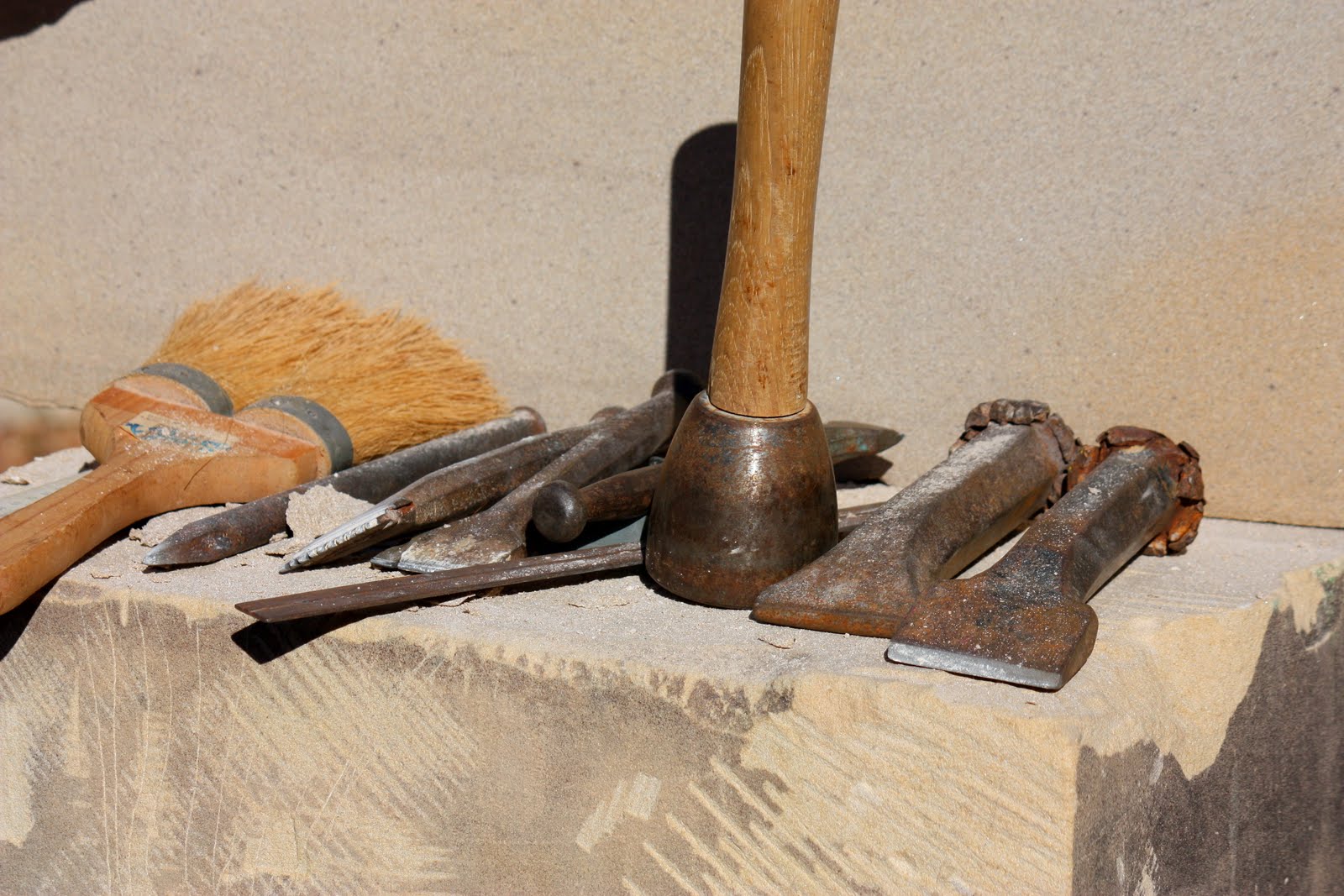
This was before the time of the great enclosures in Britain, before the growth of the industrial towns, and the drift of farm and village workers to new horizons. Youngsters dreamt of being an apprentice, of graduating to a journeyman, and finally becoming a master of their craft. At this festival just a few crafts were hightlighted: masons, blacksmiths, and cordwainers. But Sydney-town would have resounded to the work of weavers, farriers, scriveners, wheelwrights, tanners, chandlers, loriners and mercers, among others.


As I watched these master craftsmen ply their trade, I thought of books dear to me like Flora Thompson's 'Lark Rise to Candleford', 'The Stone Quartet' of Alan Garner (especially 'The Stone Book' and 'The Aimer Gate'), and even Bruce Chatwin's much later 'On the Black Hill'. All giving a flavour of a bygone era and that which is lost. Not that I decry progress; nor am I a luddite, wanting to replace blackberries with smoke signals.


Within the HPB's museum, there is a story noting that a number of fathers, sons and brothers passed through the building. Whether any had deliberately committed offences in order to reunite families is speculation. Four example, four Reilly brothers were transported from Ireland. Luke, a tailor, was sentenced for street robbery. Peter, an illiterate stone-cutter, was sentenced for stealing flannel. Francis, a shoemaker, was transported for pickpocketing. They were later joined by another brother, Thomas. This new land offered them greater opportunities than the old.

Thursday, 16 September 2010

Hobartville - a bountiful life - for some


According to the Sydney Gazette & NSW Advertiser, in March 1834, William Cox of Hobartville was assigned two male convicts, one a farm servant and the other a labourer. All through this fertile agricultural valley, the food-bowl for the burgeoning colony, from Richmond, to Castlereagh, to Windsor to Pitt Town, the landed gentry and small stake-holders, were being assigned the scum of the old continent to work their fields, run their households, and augment their own skills and efforts.


Australia prides itself on being a classless society, of being the land of the fair-go, of treating all men equally. AFTER they had served their sentence. Governor Lachlan Macquarie had been at the forefront of this push for the redemptive power of the second chance. And that is what got him into so much strife with the landed gentry throughout his term of service (1810 - 1821). Especially with the likes of John Macarthur.

But the pages of the Sydney Gazette are testamemnt to the ongoing use of convict labour in the colony throughout the tenure of William Cox (the younger) at Hobartville, in Richmond.

Thursday, 5 August 2010

Harbour Islands (5) - Spectacle Island


There are 9 islands in Sydney Harbour: Shark, Clark, Garden, Fort Dennison. Goat, Cockatoo, Spectacle, Snapper and Rodd. Thus far, I have blogged on Shark Island, Goat Island, Garden Island and Cockatoo Island. Recently, I accompanied 60 intrepid salts from the Maritime Museum out to Spectacle Island.

Spectacle Island lies between Cockatoo Island and the Birkenhead Point peninsular on the western side of the Harbour Bridge. Controlled by the Navy, it is not open to the general public and tours are rare occurrences. It is used for training courses for naval tactical response groups and to house the Naval Heritage Collection, which collects and stores naval items for display at Garden Island and travelling exhibitions around the nation.


Originally two small islands connected by a tidal isthmus -hence its name - the first building on Spectacle Island was a convict-built powder magazine completed in 1865, designed to take some of the pressure off Goat Island. The chief engineer was George Barney who also constructed Victoria Barracks, Circular Quay and Fort Denison as well as the moat on Goat Island. The magazine, seen here, was constructed of rock from the island as well as from nearby Cockatoo Island during the construction of its Fitzroy Dock.


Commander Shane Moore, who live on the island, was our guide through the heritage collection. His knowledge is deep and it is personal. He knows the origin of every item in his massive collection, that ranges from Spanish canons, through ships bells, naval uniforms (including buttons), ships insignia and regulation eating utensils.


The two hour tour is not long enough to do this remarkable island justice. The group from the Maritime Museum was gobsmacked at every turn. We saw the ship's compass from the German cruiser, Emden, destroyed off the Cocos Islands in 1914. There is Mawson's sled from his Antarctic expeditions.

A truly remarkable collection stored on this island in the harbour that most Sydney-siders do not know exists.

Wednesday, 19 May 2010

Goat Island - The Queen's Powder Keg

A unique design in the wall ensuring that the building imploded if there was a 'problem'. He explained how it worked but ... duh!
Goat Island's usage can be neatly categorised by century.

During the 19th century it housed convicts who were used to quarry and cut the sandstone for use on the island and in the town. The strutures so built were used to house gun-powder.

During the 20th century the island was used to house water and police patrols and extensivley as a ship-building dock.

During the 21st century the island will be used as a vehicle to introduce the people of the city to their own history.

Left: 1870 photographed to the south from the north shore showing Balmain behind the island;
Right: about 1910 once again from the north shore but this time more in a SEE directon showing Balmain and part of Darling Harbour
The quarrying commenced in 1826 when Governor Darling moored the hulk Phoenix off the island to use its convicts as labourers to build a naval arsenal. However, its use as a quarry, although intensive, was short-lived when the new governor, Bourke and Thomas Mitchell realised they would end up with no island at all!

There was a need to store the huge quantities of highly explosive black gunpowder used around the town, and the island was perfect. As hundreds of wooden barrels were required for storage, coopers and a cooperage were also required.

Top Left: the walls and buttresses of the powder magazine;
Top Right: The cooperage along a hewn sandstone wall
Below: the facade of the Queens Powder Magazine.
George Barney was the engineer in charge from 1836. He had already constructed Victoria Barracks, Circular Quay and completed Busby's Bore. Progress was slow as the 171 convicts only worked hard enough to stay out of stife, had to wear shackles and were shipped on and off each day. Barney solved all these issues. He's one of my heroes this bloke. The works were completed by the end of the decade and the convicts moved on to hacking away on Cockatoo Island - another beaut day trip.

The inside and structure of the magazine. The guide, David, was well informed, enthusiastic and had a great sense of humour.
In 1861 there was over 7,000 barrels of gunpowder stored on the island – equal to about one million pounds of gunpowder, enough to blow half of Sydney sky high.

Left: aerial view in 1951; Right: aerial view in 2002
National Parks & Wildlife is readying the island to open to the general public by regular ferry from CQ, probably by the end of 2010. In the interim, they are open to groups. I went with a group from the Maritime Museum. Early in July I am going with a Historic Houses group for a dramatised day linking Hyde Park Barracks with Goat Island entitled 'Escape of the Cracksmen'. Hope they dress up!!
The view from Goat Island early in 1930