Showing posts with label The Domain. Show all posts

Wednesday, 7 October 2015

St Mary's Cathedral - From a distance


Photography can be deceptive, I suspect you might agree. It is all in the framing.

This first image was taken from the viaduct that separates The Domain from Wooloomooloo. Not sure why the viaduct is there: it does not carry water, it does not carry cars. It allows pedestrians to cross from Cook+Phillip Park over to The Domain, and hence to the AG-NSW. It is excessively ugly when included.


As you can see from this second image showing the viaduct obliterating the beauty of St Mary's Cathedral. This was taken from the intersection of Riley Street and Sir John Young Crescent, the head of Wooloomooloo Bay, prior to it being retained by a wall, and extensively retained, in the 1860s.


This third image was taken having crossed the viaduct and on my way across the grassy expanse of The Domain sports fields. I looked back, judiciously framed my shot, removing all ugly, and just showing a magnificent contrast of old vs new. The new is the building in which my daughter currently works; on the 22nd floor.

Below is a paining by Geoge Lambert in 1849. It shows the ridge upon which St Mary's Cathedral is now located. Actually, the original St Mary's is in the painting, but the new building was swung around to be north-south. The church with the spire is St James.


Friday, 25 September 2015

The Macquaries were "greenies" ...


To my way of thinking, this pair left an indelible mark upom the structure, and the style, of Sydney. They lodged at the first government house from 1810-1821. He reorganised the layout of the streets, no mean feat considering the topography with which Sydney is blessed. And yes, he named one of them Macquarie, and another Elizabeth.


He confirmed Hyde Park as a leisure ground for the peopke, and set aside bothThe Domain, and the botanic gardens.

She, by her perambulations, set in concrete the road from Bridge Street to the point named after her. She also was heavily involved with both the orphans home, and the female factory out at Parramatta.

Given the social structures of their time, they wee progressives, who gave transgressors another chance after they served their time.

Sunday, 20 September 2015

Mrs Macquarie's Point


Our forebears were really wise, and reserved much of the harbour foreshores on the southside for public recreation. Here is some of it.

Elizabeth Macquarie shared her husband's passion for aesthetics. This was a new and rough land they were trying to civilise. The indigenous inhabitants used the land in a totally different way to those born and bred in England's "green and pleasant land". If the Aborigines wanted fresh green shoots, they used fire. If the colonists wanted green shoots, they planted trees from their homeland. Eucalypts and acacias are more olive green than "Jerusalem" green.


This aerial view of the southern shores of the harbour is an excellent overview of the results of the vision of the Macquaries. This shows the Royal Botanic Gardens and The Domain. I have included a labelled version, too, down below. From the left, the three inlets: Wooloomooloo Bay, Farm Cove, and Sydney Cove. The two Peninsulas: Mrs Macquarie's Point, and Bennelong Point. Garden Island is out-of-sight to the left. The harbour bridge is out-of-sight to the right.


My two photos were taken from the tip of Mrs Macquarie's Point looking across Farm Cove to the city skyline, and Government House, nestling in the trees of the Botanic Gardens. This was the home of the Governors of this state, New South Wales, from 1845 until the present day (with two small breaks). Of course, there is a mucho impressive view from the tip of Elizabeth's point looking across the harbour itself. Show you this tomorrow.


Friday, 18 September 2015

Pinchgut


There are nine islands in Sydney Harbour:
  • Clarke
  • Rodd
  • Goat
  • Garden
  • Spectacle
  • Snapper
  • Shark
  • Cockatoo, and
  • Fort Denison.
This is Fort Denison, originally known as "Pinchgut". It was a little mound of a thing, in the main channel, just off the end of Bennelong Point (where the opera house now is). The first colonial settlers banished to this island transgressors that they did not hang. Sans food. Hence, the colloquial name. The mound is no more, indeed, the island is covered with a tiny fort, with its Martello tower. It is very expensive to travel to. Hence, this is as close as I will take you.


I had walked the length of Lady Macquarie's Drive in The Domain. To say it has wonderful views is an understatement. The flowers, hardly native, were a delight, so I dropped to the turf for a photographic "fiddle".


Then I turned east to take a shot down the harbour, towards the heads (not in sight). This first headland, is the tip of Garden Island, which is no longer an island, a dry-dock having breached the gap in 1942. See the Manly Ferry way down stream, as it rounds Middle Head for the journey upstream to Circular Quay.


Thursday, 17 September 2015

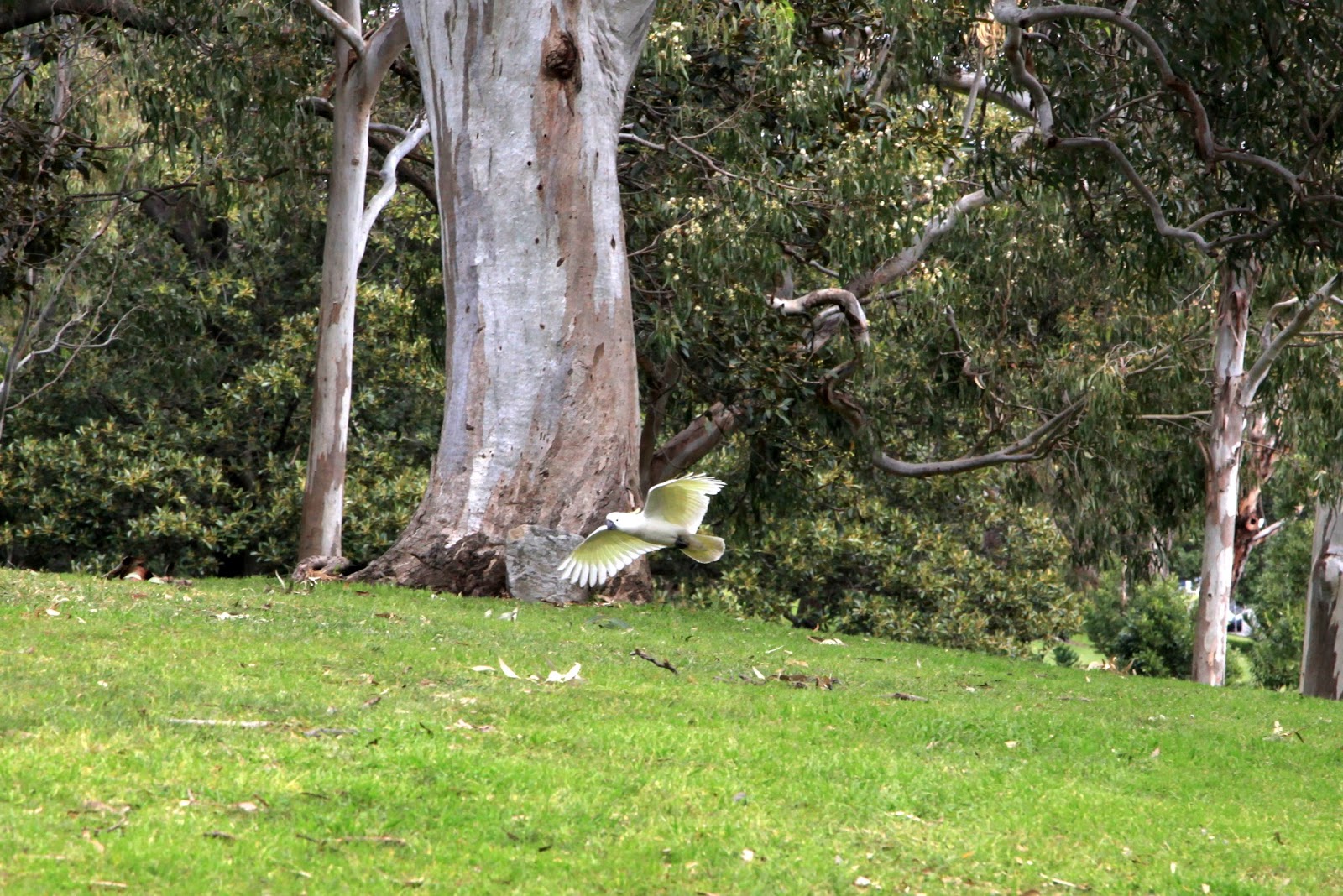
An earful of Sulphur-crested Cockatoos


Yes, I acknowledge that the Sulphur-Crested Cockatoo is not a universally appreciated bird!

But this flock, along Mrs Macquarie's Road, in The Domain, were a gregarious, inquisitive mob.


Two of them, at least, have been tagged.

"Earth to D48. The coast is clear. Come on down!"


Tuesday, 8 September 2015

The Domain - Veil of Trees


"Veil of Trees"
Mrs Macquarie's Road, The Domain
Created by Janet Laurence & Jisuk Han
Installed 1999

The creation of a passage of reflection, a space where memory is gathered. Memory is embodied within each glass panel – traces of minerals, ash and seeds of indigenous trees are enclosed together with excerpts of Australian poetry and texts selected for their evocation of the nature of trees. Amidst the translucent glass panels a ribbon of one hundred Red Forest gums – eucalyptus tereticornis – which once forested this site have been planted, each tree grown from the seed of the original Red Forest gums which existed prior to European settlement. Weaving either side of the ribbon of forest and panels clumps of native grasses define the linearity of the passage, engaging the visitor into, along and through this site of regeneration.


One of the fragments of a poem, this one by Judith Wright called "The Cedars":
For it is anguish to be reborn and reborn:
at every return of the overmastering season
to shed our lives in pain, to waken into the cold,
to become naked, while with unbearable effort
we make way for the new sap that burns along old channels-
while out of our life's substance, the inmost of our being,
form those brief flowers, those sacrifices, soon falling,
which spring the returner demands, and demands for ever.


Monday, 16 March 2015

Running about the braes with Robbie Burns


Squatting on the concrete steps beneath the plinth of the Robbie Burns statue along Domain Road, I wondered why on earth it came to be there. The statue. Sure there must be a Burns Society in Sydney. Well, the metal plaque on one of the garden seats in the attached garden mentioned the society. The statue has a grand location, along Domain Road, halfway between St Marys Cathedral and the Art Gallery of NSW. The Domain Trust must have been replete with Presbyterian Scots at some stage. Wily Scots, with lots of well-heeled benefactors.


The gardens surrounding the statue are being remodelled. They seem to be a smidge confused about whether they want annuals, biennials, or perennials. This large rectangular bed, in pride of place, is a case in point. Being filled with veggies, and all. Tempting to add a lettuce leaf or three to my Sub. However, the effect in the garden is impressively attractive.


Saturday, 14 March 2015

Sydney Skyline - from Farm Cove


There ius a 90 degree pivot between these two shots, as a storm brewed last Sunday afternoon. The first shot was facing south-west. The second shot was facing north-west.

Farm Cove is the inlet on Sydney Harbour immediately to the east of Sydney Cove, where all the ferries choof and chugg. Hugging the brick retaining wall of the cove, is the green expanse of the Royal Botanic Gardens. The RBG morphs into The Domain. The Domain morphs into Hyde Park. This is quite a vision that Governor Lachlan Macquarie (1810-1821) bequeathed to the citizens of Sydney.


This is one of the "You are Here" signs just inside the gates of the RBG. I have adjusted it to suit this post. X marks where I stood to take the other two images.


Tuesday, 5 June 2012

Taphophile Tragics - Ego's folly


This is one of the most visited memorials in Rookwood, indeed, THE most visited. But I guess that is because it is presented in a particular way that appeals to the egalitarian nature of most Australians. And because it is on the schools' visiting programme. For mine, it is the salutary story of one who believed his own promotion.


John Frazer was a mercantilist of the nineteenth century, a shopkeeper if you will. Not to denigrate that noble calling, but it is just the way you earn your living. No more, no less. Not in my eyes. It is what you DO with your wealth, should you have the skills and the wit to accumulate same, that may justify your place in history, if that is what you crave. Frazer sought to memorialise himself to his city, by building water fountains to enable the citizenry access to fresh water as they go about their day. There is a Frazer Fountain in Albert Square, at the entrance to Domain Road, opposite St Mary's Cathedral. There is another Frazer Fountain in Hyde Park North at the pedestrian crossing over College Street to access Sydney Grammar School. This latter has been moved twice already as the city grew around it. The Albert Square fountain has had its water disconnected because of the futility of trying to access it in the middle of a traffic roundabout. A classic folly in pursuit of renown.

Yet Frazer's most grandiose folly is the monument built to house his mortal remains. Its footprint is in the shape of a giant tear-drop, bordered by a wrought-iron fence of which the lead photograph is part. Frazer died in 1884, leaving an estate of 405,000 pounds. Although others of his family were also eventually interred in the vault, due to fears of vandalism, the remains were more recently dis-interred and cremated. His descendants donated the monument as a shelter for birds, asking that the high windows be removed to allow them access. Within 6 months, the windows had to be boarded up again, because the birds were attracting vermin.

So rather than a testament to John Frazer, Esq., the Frazer Vault stands as a testament to the workmanship of stonemasons of the past. Egalitarianism will have out.

Thursday, 27 October 2011

What you see is what you get!


As we walked from the Art Gallery through The Domain to the Sydney Hospital to get a coffee, I was taken by this storm building up in the west, behind the CBD. So, I took the shot which I have posted second. But it wasn't what I saw. Because, said my daughter, you metered off the buildings. Try metering off the clouds.

So I did, and got the shot which I have posted first. This is what I saw. Both shots vary only in shutter speed. They are F8, ISO=400, with a Focal Length of 60mm. The bottom shot has a shutter speed of 1/1250, whereas the top shot has a s/s of 1/3200.

By the time we got there, the coffee shop was shut.

Saturday, 8 May 2010

Nil bastardo carborundum


Starting life as an English colony, many of our customs and institutions are based on the British model. As we gained our independence peacefully, respectfully and democratically, we had no reason to overthrow these customs and institutions. The centre of my city resonates with English names. We have a Hyde Park, we have a George Street, and we have a Domain.


The Domain (Demesne) was officially established in June 1816, but the land was set aside for public use way back in Phillip's governorship. During the early 19th century, there was much hoohaa by developers who bemoaned that such fine harbourside land was set aside for plants and flowers. Do property developers never change?

In the early 1960s a swathe was sliced through the land to accommodate the Cahill Expressway and the dominance of the motor car, effectively splitting the Domain from the Royal Botanic Gardens. The '60s was a water-shed time in many ways, and by the end of that decade a social institution within the Domain was withering on the vine.


Along the pathway which now edges the Cahill Expressway, on a Sunday afternoon, could be found the misfits, the misguided, the enthusiastic and the bombastic. this was the site of 'Speakers' Corner' modeled on the 'corner' in Hyde Park in Londoon.

My older brother would drag me along to hear this bloke, or that bloke, to raz, to puzzle, to laugh and to be embarrassed. There were communists, sexual liberationists, republicans, monarchists, anarchists and plain nutters. It was absorbing.


The speaker/ranter with the most reknown was simply known as Webster. He would mount his wooden step ladder, and hold a massive crowd enthralled for a couple of hours, responding to all interjections with wit, alacrity and a snearing disdain. It was his style. His audience lapped it up.

Webster died at the end of 2009 in Tasmania. He was well into his 90s. The government refused to allow his ashes to be buried in the Domain, so late one night, when the clouds were dark and stormy, a small band of admirers snuck down there and cast his ashes to the wind.

This memorial is not just for Webster, but for the social institution that was 'Speakers' Corner'. Nil bastardo carborundum - Don't let the bastards wear you down. Fight back! Speak your mind. Have an opinion. Work out your personal ethics and stand firm.

Thursday, 29 April 2010

Statues - Henry Lawson


Dare I make a bold claim about Henry Lawson? He is a writer much derided in his own land, yet much loved as well. He has not translated into the modern age very well, hasn't our Henry. He was a product of this land, at that time - for much of the 19th century, the country called Australia did not exist. We were just a collection of independent states.

So the bold claim? Henry Lawson is to Australia as Mark Twain is the the United States. What about Banjo Paterson I hear the pundits splutter? Or C.J. Dennis or Adam Lindsay Gordon, or Henry Kendall I hear interjected from the bleechers!


Lawson almost single-handedly defined the mythical Australian in his landscape. He created the ideal of the sun-burnt battler humping his bluey around the outback blocks of this state, living off his wits and ever sus of them city-folk in their finery with their fancy ideas.


Lawson was prolific in the period before the demon drink got her claws into him. He was well served by George Robertson (of the booksellers, Angus & Robertson), and by J.F. Archibald (editor of The Bulletin). He also had Banjo looking out for his legal interests. Mainly two women, his mother and his wife, who always gave him curry. Every time Henry was locked in the clink or dead-drunk in the gutter, his mates would hand the hat around, and Henry would live to write another day.

Lawson's journal, exhibited in the Centenary '100' by the State Library of NSW

Try but two of his short stories: 'The Loaded Dog', and 'The Drover's Wife' to get the flavour of his definiton of life in this wide, brown land.

As for his poetry, I have already posted 'Faces in the Street', and 'One Hundred and Three'. Seek out 'The Roaring Days', and 'A Voice from the City'.

It is ironic that this statue puts Lawson on a pedestal - that is the last place he would want to be. But one calm, starry night wander through Sydney Hospital, across the Domain and down Mrs Macquarie's Road. Just as the loop divides, in the centre beneath a gum-tree, there you will find Henry, his dog, his mate and his swag ready to entertain you with ballads from a land that maybe no longer exists, if it ever did.

Portrait of Henry Lawson, painted in 1913 by Florence Rodway, held by the State Library of NSW