Showing posts with label York Street. Show all posts

Thursday, 23 July 2015

Facades of Clarence Street


In the Central Business District (CBD) of my city, there are two ridges whch run north-south, from about the Town Hall all the way down to Circular Quay. One ridge runs along Macquarie Street. Another ridge runs along York Street. But I have the chicken before the egg, because, of course, the street was laid out to traverse the ridge. You with me?


Macquare Street, on the eastern ridge, is the home of government, medical specialists, the landed-gentry and mercantilists. York Street, on the western edge is replete with 19th century warehouses. In between these two is the retail quarter, closer to the Town Hall, and the business quarter, closer to Circular Quay.


The ridge along York drops north toward the Quay, and also drops west toward Darling Harbour. The streets of any length to the west of York Street are: Clarence, Kent, and Sussex.


Each of these three streets has a hard-yakka provenance, wedged as they are between warehouses, engineering concerns, and the dockyards and piers of the eastern side of Darling Harbour. One of the good things about these streets, is that many of the buildings from the second half of the 19th century are still standing. Handsome on the outside, but modernised on the inside. I can live with that.


Thursday, 26 March 2015

Classified by the National Trust - 83 York Street


"Paul Reader" is a winter sport's store at 83 York Street, in the city. The firm was established in 1956 by Paul Reader, who tried most of the major north-south streets, before settling on York Street in 1987, when son took over from father.

Classified by the National Trust, this ten-storey building was built in 1913 with a brick and sandstone facade. It was refurbished by Lipman's in 2001 and is currently valued at $90m.

The dyadic neon sign caught my eye. They are not much in fashion nowadays, this style of neon sign.

There is a very small winter sport industry in Australia, as the arrival of snow is unreliable, as is its quantity when it does arrive.


Monday, 23 March 2015

CBD - Bringing laneways to life

Interesting results from a meander down York Street on Saturday, from Town Hall to Carrington Street at Wynyard, to catch my bus.

Waiting for pedestrians to walk across my stage does not always improve the shot, but does provide information on what to look for next time.

The three guys in Mullins Street added nothing to the image. They just stood there. One person walking ar gesticulating is better. They took f.o.r.e.v.e.r.

I quite like the empty driveway in the pair below. One bloke would've been better than two, but caught at the right-hand drain-gutter. I was back an appropriate distance to allow the figures to provide perspective on the size of the built landscape.

The final pair of shots did not work at all. I had taken these on a previous meander down towards the Quay. Too many directions: Person 1 coming toward me; Person 2 cutting across me. Person 2 is way too big, meaning I should have been on t'other side of road. The splash of red is nice but the bollard cuts across the perspective down the lane.

Lots to teach myself.
Mullins Street between York and Clarence Streets

This is not a named lane, just the back entrance to the "Clarence Street Cyclery"

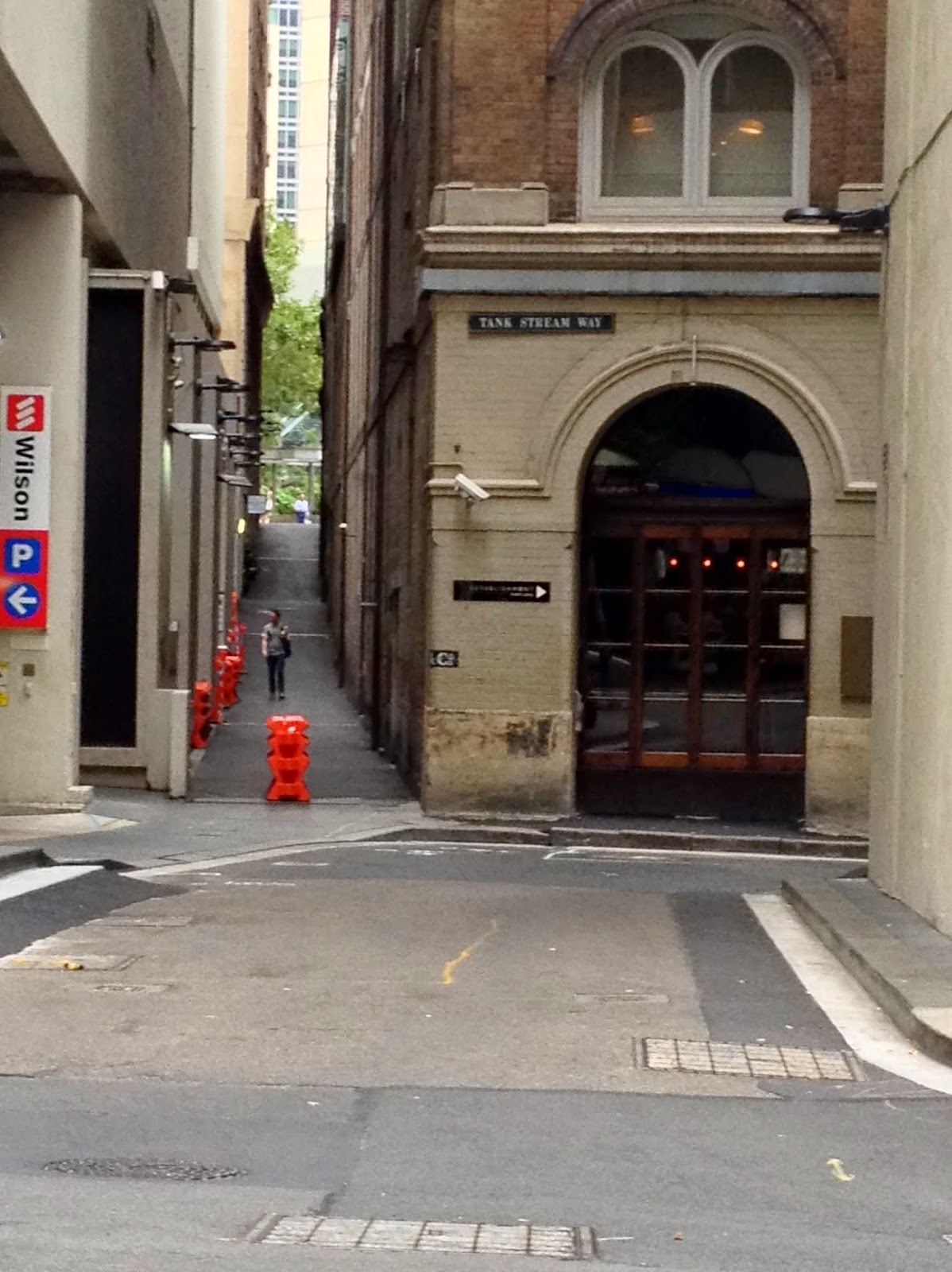
Although I am standing on Tank Stream Way to take the shots, the passage is Abercrombie Lane.

Saturday, 21 March 2015

A dwarfed Sydney Town Hall


I was standing at the intersection of York and Market Streets. My faher worked In D & W Murray (Wholesale Haberdasher) on this corner from 1935 (aged 14) until he joined the army in September 1942. (aged 21). I like York Street, as it has retained many of its early buildings.

On the left is the massive Queen Victoria Building (QVB) which was built between 1893 and 1898, and has had numerous face-lifts since then. I remember borrowing books from the City Library which used to be housed therein. That was where I was first introduced to Charmaine Clift. Who? I hear you ask. Nevermind.

Wednesday, 17 December 2014

A stitch in time ...

Not long ago, I showed you the ediface for Lincraft, which is a handicraft shop, just down from the QVB. Today I show you the display windows for Morris & Sons, also a handicraft shop, a wee bit further down York Street. The two shops could not me more different in tone.

Lincraft is all bright lights, and goods-a-tumble. I believe it could be described as cheap'n'cheerful - except handicrafts are rarely cheap. Morris & Sons is discreet, with subdued lighting, and sales assistants who maintain their cool demeamour.

Monday, 24 November 2014

The answer lies in the soil ...

I am not sure what the expression "The answer lies in the soil" means, exactly. I kinda think it means that to solve anything, one needs to go back to basics. I am a gardener, and I adore getting down, and getting dirty. But, the expression has a wider and more general application. Gardening is becoming more onerous, as my balance and vision become more neurologically impacted. What more sedentary activity to replace it with. I adore reading - bought myself Colm Toibin's "Norah Webster" on Saturday - but reading can only be done for about 30 minutes at a time.

So, I went into Lincraft on York Street and bought some wool and needles. Will graduate to crochet early in the new year. Lincraft is a chaotic store that stocks sooo much. And the prices are reasonable, although the quality is not crash-hot.

Sunday, 26 January 2014

Sydney from on high (3)

Looking down upon the 1898 Queen Victoria Building (QVB), which many would assert is the centre of this city. It is bounded by George Street (where the big, red bus is), York Street (on the other side), and has Market Street running east-west along the RHS. Market St is eponymous with the QVB which is the site of the original municipoal markets, the site having been reserved for such a purpose in 1810 by Governor Macquarie.

Friday, 17 January 2014

Dr Lang's Church

Here I am back at Church Hill again. It really is an under-rated - indeed, unknown - part of Sydney's history. Thus far, I have told you about the second St Phillips which stood on Church Hill from 1800-1856, and the third St Philips which was consecrated in 1856 and is still active today. Then I told you about the amalgamation of St Philips and The Garrison Church into the Parish of Church Hill.

Today, I will introduce you to "Dr Lang's church".
This incarnation of Scots Presbyterian Church stands today on the original site of St Andrew's Scots Church, the foundation stone of which was laid in 1824. This is the corner of Jamieson Street and York Street. This building only dates from 1930. Previously, a centenary service was held in the original The Scots’ Church on Sunday 18th July 1926, and the building was demolished a few months later, to enable the widening of York Street for the southern approaches of the Harbour Bridge.
So, what did the original Scots Church look like? Here is an engraving from 1842. It was designed by Edmund Blackett.
The moody photograph below is by Harold Cazneaux, and was taken immediately prior to its demolition to enable York St to be widened for the Harbour Bridge.

And now to Dr Lang. The Rev’d John Dunmore Lang arrived in Australia in May 1823. He conducted the inaugural service of the Congregation on 8 June 1823. A Crown grant of land was given to him by the Governor in order to build a church. The block was located on the corner of Jamieson Street and York Street in an area later known as Church Hill. On 1st July 1824 Governor Brisbane, also from the same part of Scotland as Dr Lang, laid the Scots Church foundation stone. A stone church, with a plain tower, seating 1000 people, was opened on 16th July 1826. The actual cost was £3000 and it was opened with a debt of £1480. The Rev’d Dr John Dunmore Lang had a long and distinguished ministry. He was also an outstanding statesman and personality, being active in civic, educational and government circles as well as in the Church.

On 14th October, 1856, my great-great-grandfather, Thomas James Selby, married my great-great-grandmother, Mary Ann Puckeridge, in Dr Lang's Scots Church. Thomas was 19. Mary Ann was 17.

Friday, 4 May 2012

When I'm cleaning win-ders

Could it be, is it possible, that any of you are old-fashioned enough to remember George Formby?

This is my contribution to the Weekend in Black and White community.