Showing posts with label Night. Show all posts

Friday, 21 January 2011

Sydney Scherzo

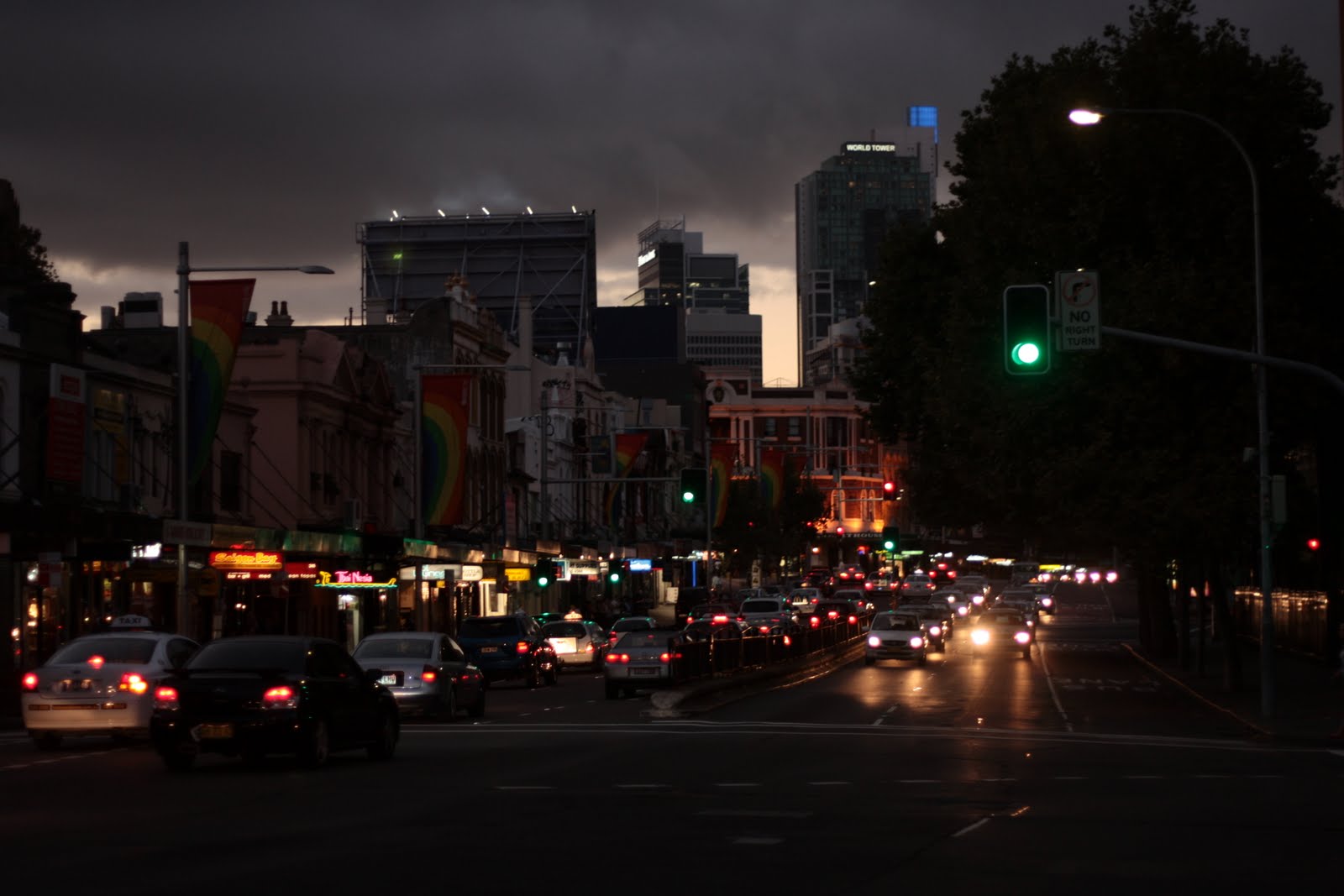
Oxford Street, Paddington looking east outside the Verona Cinema
We, an unabashed people,
Yarning, gibing, protesting about what's right or wrong with us,
All the long, crowded day, in the windy gold and the blue;
Hurrying or sauntering workwards at all sorts of times in the morning,
With rattle of myriad heels like the noise of a creek;
Leaning from windowed eyries hundreds of feet above water,
Or far away down in a garden, collapsed on a spongy lawn;
Trapped in a shoppers' jostle of bags and intolerant elbows,
Or hemmed by irrascible ears where bullocks were wont to plod;
Making and buying and selling, handing out tickets and dockets -
We rebel against the great city, we cavil and chafe at the clamour,
The crush, the heat, the struggle, but still say 'Yes' with our hearts.
John Thompson

Oxford Street looking back towards Taylor Square

Saturday, 1 August 2009

Theme Day - Night


The Monthly Theme Day is a project shared by many City Daily Photo Bloggers from around the world. Click here to view thumbnails for all participants

Tuesday, 30 June 2009

Vice regal incongruity


Taken at Government House in Sydney's Botanic Gardens, these photographs surround a concert given by William Barton under the aegis of the Historic Houses Trust. With unbelievable inner resolve, I managed to still my trigger finger during the concert itself. Why is this incongrous?


Government House is of the establishment; William Barton is an indigenous Australian who is probably the foremost exponent of the didgeredoo in our country today. I felt goose-bumps up my spine as I watched him perform into these microphones under the watchful eye of King George V of England and her colonies.

Ooo ... how I wish I were one of those rudies who just flashes away with the hide of a rhino!

Monday, 29 June 2009

Tuesday, 16 June 2009

Vivid Sydney - Fire & Water

Vivid Sydney was the inaugural festival of music, light and ideas which ran from 26 May through until 14 June around Sydney Cove, The Rocks and Millers Point - the historic heart of the city.

Thomas McKinnon - 20 years; Fingal Lanahan - 7 years; Brendan Walsh - life; Eammon Connolly - 10 years; Milo O'Shea - life ... ... ... ...

The lilted roll-call echoed around the hushed Cove: the names of many of the 210 convicts from The Three Bees were accompanied by Aboriginal smoking ceremonies, the clinking of message sticks and the drone of the didge. These dazed members of the hoi poloi, uprooted and transplanted to this desperate place.

Life - life - life - life ...


Campbell's Cove in The Rocks resounded to a theatrical reenactment of the conflagration and subsequent sinking of the convict ship The Three Bees back in 1814 as it lay at anchor off what is now Dawes Point. With small hand-made lanterns floating in the inky waters of the Cove, a sardined-audience watched mesmerised as the drama unfolded before them - the ever changing projection on the Opera House sails creating a magical back-drop, and ferries plying their usual Saturday night trade.


Dramatically-enhanced, the narrative included said cabin boy, his bully of a Captain, hooded helpers-of-death, the Kings-own Red Coats and a computer orchestra glowing red on the nearby pier.

Accompanied by the harbingers of death and illuminated by fiery flame sticks, the hapless cabin boy was led along the Cove and dumped into a row boat for the journey out to the isle of the dead whilst the eeirie convict ship rose slowly from the murky depths, mast askew and canvas in tatters.


The performance featured music performed live by Coda, floating inflatables from Earth and artists from Stalker, Legs on the Wall, Theatre Kantanka, PACT and Jannawi Dance Theatre. The music was a cross between Philip Glass and a Red Centre corroboree. The final conflagration was fascinating and strangely affecting.


This spectacle is THE inspired piece of programming of the entire Festival - it brought our past to life; would that we had more like this. Done with a fine sense of drama (but drop the Avon calling ring tone, please) and with a reverence for those involved, there could be such a recreation around The Rocks and Millers Point each June. But please, whatever you do: don't dumb it down.

We don't have a lot of colonial history, so what we do have, please treat with respect.

Tuesday, 9 June 2009

Never more than a couple of minutes away


Five years ago, there was never one around when you wanted one. Maybe it is just that I live on the airport corridor. The drivers are more knowledgeable and friendlier and the vehicles are cleaner and more comfortable.

Yesterday, a driver (with a young family) was saying that the GFC has decimated his takings over the last two months - mainly because CabCharge is not being taken up by businesses.

This is taken along George Street near the intersection of Park Street - the premier block of the city, adjacent to the Town Hall.

Monday, 8 June 2009

Vividly Sydney


Vivid is a new festival of music, light and ideas which runs from 26 May to 14 June around the iconic foreshores of Sydney Cove. It encompasses Smart Lights, Creative Sydney, Luminous and Fire Water. These photographs cover the Smart Lights theme.


The festival drew massive crowds: the precinct was packed this evening as we wandered around. A new festival over a long weekend at the start of Winter is most welcome. Hopefully, this is a festival that learns as it goes along. It will be a massive event on the calendar once it is bedded down.

Thursday, 28 May 2009

Underneath the arch


Although I would decline to testify in court, I think these are the four oldest pubs in Sydney town. They all stand close to the waters'-edge: hence, the naval names.

These first two have been restored with panache. The Lord Nelson (1842) attracts the chrome-fittings and blonde-wood set whereas The Hero of Waterloo (1843) attracts the literary lions with leftish-leanings. They are only about 3oom apart, both down in Millers Point which is the suburb beside the southern pylon of the harbour bridge. Of course, with Sydney being settled in 1788 there were pubs established prior to this. However, they do not still exist. One of these earlier pubs was The Sailors' Arms (1831) which is the house with the veranda immediately down from The HoW in Windmill Street, but it was soon turned into a dwelling house. Pubs in Sydney prior to 1800 were mostly under canvas.


These last two are like my father's mythical axe wielded during my childhood: with six new handles and three new heads! The Orient and the FoW have had more face-lifts than Olivia Neutron-Bomb. The Orient (1844) and The Fortune of War (1828) are both in George Street, The Rocks which loops down under The Bridge. They both look a bit dodgy and my guess is they attract the brew'n'spew crowd.

Friday, 15 May 2009

Mid-month theme: Subway day


The first "central" station - known as Redfern Station - opened in 1855 with Devonshire Street as its northern boundary. The second central station commenced in 1874 on the same site with the same name. Our Central Station commenced in 1906 on its current site further to the north and with Devonshire Street disappearing into a pedestrian tunnel on the southern end of the platforms. The clock tower was added in 1921. If you look at a map of the city, it is apparent how dislocated the city became with the advent of the enlarged Central Railway Station. Streets running N-S are blocked as well as streets running E-W. This column in the Sydney Morning Herald in December 2007 is an excellent read for locals. Jim Barr is a Sydney blogger who has some wonderful posts showing railway stations mainly on the southern line.


The site to which Central moved had been the Devonshire Street Cemetery known as "the sandhills" which was consecrated in 1820. Many of the headstones and graves had to be removed to the larger Rookwood Cemetery. This station - with 15 platforms - was known as the country platforms and was for steam trains. In 1926 an 8 platform station was built adjacent and to the East for the expanding electrification of the suburban network. A further 4 underground platforms were constructed in 1974 to service the new Eastern Suburbs line.


This image, released by The Powerhouse Museum - is one of the earliest images of the third incarnation of Central Station, 1906.

The mid-month Subway theme has contributions from the following cities:
Budapest - London - New York - Paris - Stockholm - Sydney

Next month's Subway post: Town Hall Station

Tuesday, 12 May 2009

Rodin at the AG-NSW


The second maquette for The Burghers of Calais, 1885. Cast in 1972.The Burghers sacrificed themselves to Edward III in 1347 to save Calais from extermination at the hands of the English during the 100 Years War.
Row 2 Cell 1In the indecision of that last inner combat which ensues between their cause and their fear of dying, each of them is isolated in front of his conscience.
They are still questioning themselves to know if they have the strength to accomplish the supreme sacrifice.
Auguste Rodin
Dressed in sackcloth and wearing a noose around their neck, they trudged to the English camp and presented themselves to the King. At the intercession of Edward's Queen, the six hostages were spared

Monday, 11 May 2009

The symbol of The Cross


It is difficult to convey to people who do not live in Sydney, how iconic the Coke sign at the top of The Cross is. Kings Cross is an inner-city suburb of Sydney - on the first ridge eastwards - and has a reputation for crime and a range of unsavoury behaviours. When I was coming of age it was the suburb with the highest density of people per-square-whatever, although I suspect this has now been overtaken by Pyrmont.

The neon sign - erected in 1966 - dominates William Street and is a recognised Sydney meeting point, along with "under the clock at Central" and "on the Town Hall steps". This old newsprint image - taken at the end of 1974 - shows KX tunnel under construction.

Sunday, 10 May 2009

Hyde Park, Heart of the City (2)

The ANZAC War Memorial in South Hyde Park was completed in 1934 and is celebrating its 75th Anniversary this year. Hyde Park itself was gazetted in 1810 and within two days held its first football match. The War Memorial is in memory of the Australian Imperial Forces who fought in WW1. Until the first quarter of the 20th century Hyde Park South was bordered with low rise shops and elegant terraces. It was not until after the construction of the Memorial that high rise buildings began to crowd out the park and its symbolic relationship with the heart of the city.

Below is a photograph of the building of The Memorial coming to an end with the digging of the Lake of Reflections.

Friday, 8 May 2009

Hyde Park, Heart of the City (1)


If Hyde Park is the heart of this City, then the pulse of HP is the Archibald Fountain, seen here belting out a solo with St Mary's Cathedral performing back-up. This park is very much what is known as "built environment" with no unstructured areas as occur in Hyde Park in London or Central Park In New York. It is more like the Tuileries - I hasten to add though that I would never be so gauche as to make that direct comparison! Suffice to say, there are no unkempt areas; it is all manicured. For unkempt, we need to visit either Centennial or Bicentennial Parks.

St Mary's is located on College Street which runs along the eastern edge of the Park. It is the focus of Roman Catholicism in this city.

Here is an aerial photograph of the northern section of Hyde Park in 1929. It is quite ravaged-looking having just been gouged to enable the underground railway to "grow" a station beneath it: St James, which is very close to the Top LHS of the park fronting onto Elizbeth Street. St Mary's can be seen on the RHS of the photograph. In the background can be seen the abutments of a growing harbour bridge. Sydneysiders will gleefully locate Circular Quay, Government House and the Tramways on Point Bennelong. The Archibald Fountain is located in the middle of the bullseye formed by the intersecting walkways.