Showing posts with label Circular Quay. Show all posts

Friday, 4 March 2016

The short-sighted photographer


Sydney Harbour is immensely busy, and the variety of marine craft just astounding. The photographic eye must continually move, like a toothbrush, left/right, top/bottom, infront/behind.


I wached the water taxi speed out from the Quay into the morning sunshine, and disappear. I looked up, and realised that I could see the other side of Sydney Cove, unlike the previous week when my view was blocked by a thumping big gin-palace!


Sunday, 9 August 2015

Onwards and Upwards


The AMP Tower at 33 Albert Street, Circular Quay.

In 1957, after nearly a year of negotiation between AMP and the NSW Government, the Height of Buildings Act 1912 was finally repealed, paving the way for the AMP Building to rise to more than double the previous height limit. It was the first Sydney building to break the 150-foot (46-metre) height limit that had limited the city’s skyline for 45 years. I was one of the thousands of Sydneysiders who flocked to the rooftop observation platform to experience Sydney Cove from such a wondrous height! The photo below was taken in December, 1963. I am with my father.


Saturday, 30 May 2015

The ferry "Alexander"


"Alexander" pulls into King Street Wharf #4 in Darling Harbour. I took this shot from Wharf 7, Pyrmont, and then hoofed it around to ride the "Alexander" from Casino Wharf back to Circular Quay.

Thursday, 7 May 2015

Ferry, across the harbour

Drizzling with rain as the ferry, Borrowdale, eased down upon the approach to the Quay. I had scrambled aboard at Darling Harbour wharf for the short, 20 minute, trip via the Casino, McMahons Point, and finally Milsons Point, before a watchful scamper across the harbour, and into Sydney Cove.

No reason for the trip, just because I could.

Saturday, 11 April 2015

Sydney Cove - Home is where the heart is


Only missing one icon. I have the bridge. I have Sydney Cove. I have Circular Quay. I have a ferry.

To get to the missing Opera House, follow the crowd of people around to the right ...

Thursday, 19 February 2015

Semi-circular Quay

The curve of the quay wall between Wharf 1 and Wharf 2 on the eastern side of the quay.

In the beginning ... the head of Sydney Cove was a tidal mudflat where the Tank Stream dribbled into the harbour. The cove, as Governor Philip noted in January 1788, was a deep harbour where ships of the realm could anchor in safety. Between 1837 and 1844 a military officer of the Royal Engineers, Captain George Barney, created a semi-circular quay, building a seawall and utilising thousands of convicts to reclaim about four and a half hectares of mudflats behind the wall; most of this fill came from the sandstone precipice dividing the two ends of Argyle Street, resulting in the Argyle Cut. The rest was cut from what is now the Tarpeian Walk adjacent to the Opera House forecourt.

Left: A sketch by Jacob William Jones in 1845 (SL-NSW);
Right: The balaustrade that sits atop the sandstone sea wall constructed by Barney and his iron-gangs.

It was not until 1854, however, that the quay was completed with the closure of the space where the Tank Stream entered the cove. It was after this closure, that the populace started to warm to the name "Circular Quay", even though the space is more a semi-oval. The Tank Stream now enters Sydney Cove in a storm-water drain just as you round Wharf 6 for the stroll along the front of the Museum of Contemporary Art (MCA).

Left: A bustling Circular Quay in 1870 (National Archives of Australia number A1200, L85037 TLF resource R2583)
Right: Barney's wall beside Wharf 2

Monday, 2 February 2015

Water, water every where, nor any drop to drink


One of the reasons Sydney is sited where it is, is because the scouting party in January 1788, spotted a stream of fresh water trickling into a wide, deep cove. The stream became known as The Tank Stream, and is now totally underground. The cove was named Sydney Cove. Where the Tank Stream meets Sydney Cove is Circular Quay.


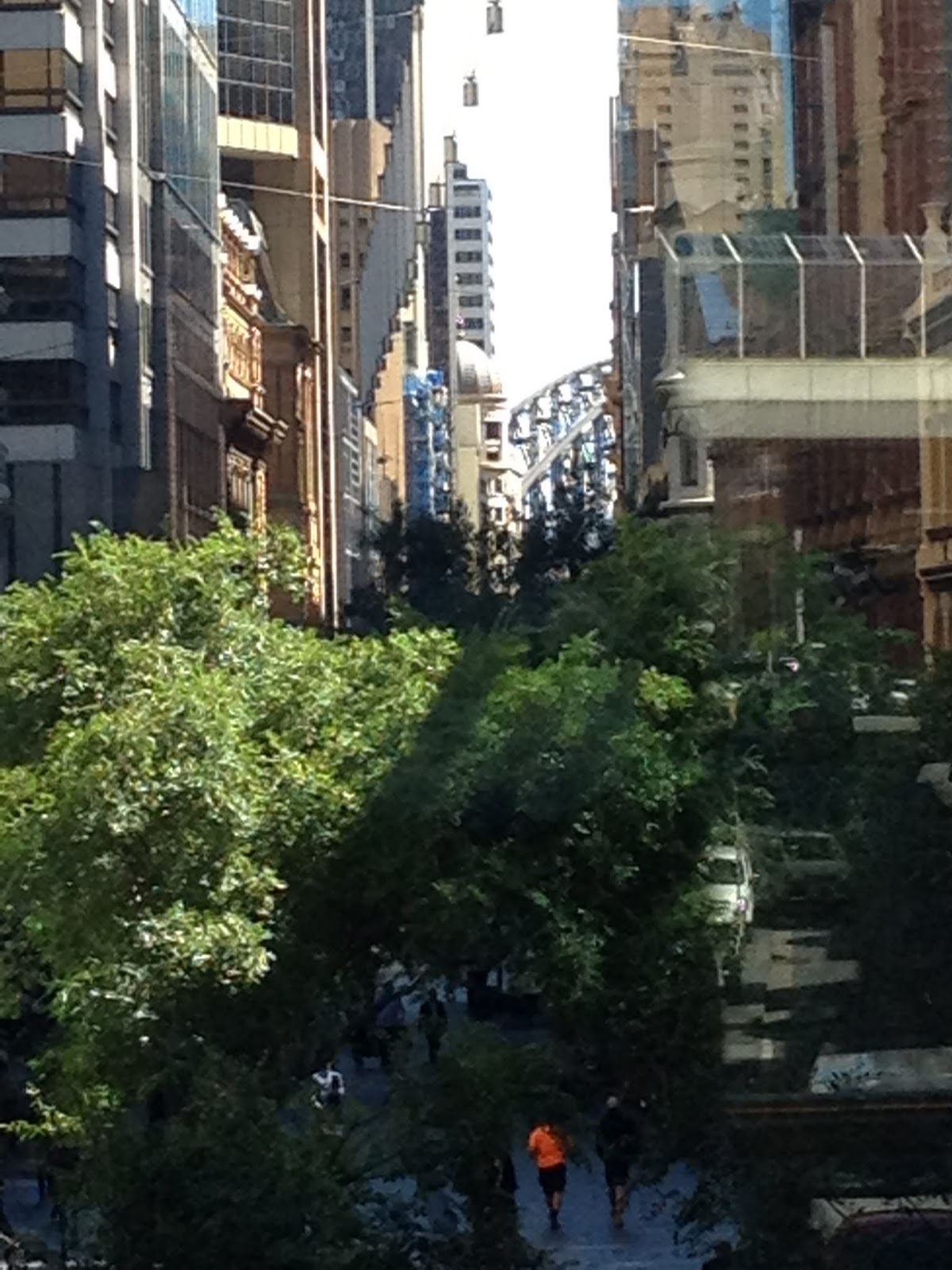
This metal plaque is in the Pitt Street Mall. The Tank Stream was not long, perhaps a little over a kilometre, and it was more a trickle than a stream. It raised in a swamp as you can see from the diagram. I have included two views down Pitt Street, ie facing north. The second shows the storm-water drain that flows into the tunnel beneath the surface which is the current day stream. The first one shows a sliver of the harbour bridge right down and beyond the Quay.

The Tank Stream provided fresh water for the colony for about 40 years, being replaced by the pipes of Busby's Bore which came all the way from the sandhills of Centennial Park. Very quickly the new settlers became aware of the fragility of water supply in a continent like Australia. And they did themselves no favours, by degrading and polluting the stream with human waste and the waste and carcasses of animals.

Friday, 30 January 2015

Sydney Ferries - the Super Cats

There are only four vessels in the "Super Cat" ferry class:
the Louise Sauvage
the Saint Mary McKillop
the Susie O'Neill, and
Super Cat 4.
The top image shows the "Louise Sauvage" coming in to berth at Circular Quay. The lower image shows "Super Cat 4" motoring past Admiralty House (the Sydney Residence of the Governor General) on its way to Watsons Bay.

These four ferries primarily run the Eastern Suburbs route, F7, which includes Elizabeth Bay, Double Bay, Rose Bay, and Watsons Bay adjacent to South Heah. These four vessels entered service between 2000 and 2001. Susie O'Neill was an Olympic swimmer. Louise Sauvage was a paralympic wheelchair-racer. Saint Mary McKillip was a Roman Catholic nun canonised in 2010. Then, I guess they ran out of names ... or something!
See the other ferry posts in this series:
Sydney Ferries - First Fleet Class
Sydney Ferries - More First Fleet Class
Sydney Ferries - The River Cats
Sydney Ferries - the Super Cats

Tuesday, 27 January 2015

8. What wouldn't I miss? Our ignorance of historical significance ...

The top image was taken from the far-eastern end of the Cahill Walk, as soon as I alighted the lift from the quay. I am facing west. The bottom image was taken during 1931. The bridge itself has been constructed - now for the fit-out and approaches. It is one of the images displayed in The Pylon Museum, which is worth your attention. There are 200 steps, and walking is the only option. As a Senior, it cost me $8.50. But only bother if there are NO cruise ships at the Overseas Terminal!

So, why do I feel a need to whinge about our collective ignorance of historical significance?

Sydney Cove is the birthplace of European civilisation in this city, nay, this nation. And LOOK how we honour it! (Must remember not to overdo the exclamation mark in this little rant.) Sure, Sydney has always been a working harbour, and I respect the history of our harbour, and the people who have worked it. But really what we have here is a developmental pig-sty. Once the Cahill Expressway cut across the head of the cove in the mid-'50s, the die was cast.

The First Fleet anchored out there.
Captain Arthur Phillip raised the Union Jack 50m behind me.
The convicts pitched their tents on the left.
The soldiers, and military bureaucrats, pitched theirs on the right.

And today we have el-cheapo eats, not-so-el-cheapo eats, buskers, convenience stores, ice-creameries, and assorted stores purporting to flog mementos to gullible tourists!

If I had to, or chose to, leave Sydney, I would not miss our attitude to the past. But this attitude, is a national characteristic, I am afraid.

Thursday, 15 January 2015

Monday, 12 January 2015

Circular Quay - Sea-horse motif

This is the motif on the railing that winds through the Circular Quay wharves. It is quite different from the railing around the rest of Sydney Cove. This Sea-horse motif echoes similar motifs which decorate the railway station immediately behind the wharves. It was recenly pointed out to me that a Star-fish was now to be called a Sea-star, because it was not a fish. A Sea-horse is not a horse, so ...

Sunday, 11 January 2015

Sydney Ferries - More First Fleet Class


During summer, there is a different passenger liner docked at the Overseas Terminal in Sydney Cove, every week. It is great fun to watch the small, working boats reverse out of Circular Quay (CQ), chuck-a-uie, then head out into the harbour past this massive looming hulk. I watched as the "Charlotte chugged out into the harbour, passing the "Friendship" coming in to dock.


As I noted in my previous post, the Sydney Ferry network has 28 vessels, covering six classes of ferry. With nine vessels, the First Fleet class is the largest in numner, if not displacement. All Sydney Ferries depart from a wharf at Circular Quay, which has six double-sided wharves. Turnaround is quite speedy.

In the ferry network, there are seven routes:
F1 Manly (light blue)
F2 Taronga Zoo (dark blue)
F3 Parramatta (yellow)
F4 Darling Harbour & Balmain East (purple)
F5 Neutral Bay (red)
F6 Mosman Bay (lime green)
F7 Eastern Suburbs (jade green)

Thursday, 1 November 2012

Theme Day - The Water's Edge


Originally, Circular Quay was not circular at all; it was a tidal mud-flat, with a slash - in the south-western corner - where the Tank Stream entered Sydney Cove. Hah! A corner in a circular shape - boggles the mind, eh what? The engineer, George Barney, was allocated a team of convicts to shape up the cove from about 1836 when mercantilism was the colony's saviour. At that stage, that landward side of the cove was known as 'semi-circular quay".


Between 1860 and 1880, it took on the shape that we see today; the Tank Stream went underground, the edges were buffed and lined with wool stores and gang planks. If you wander from the Opera House around the 'circular' bit to the Museum of Contemporary Art, you will notice, perhaps, bronze plaques indicating the water's edge at various years from 1788 to today.


The two, large colour photographs I took on Wednesday evening as I wandered across the Cahill Expressway from the Botanic Gardens to the Glenmore Hotel in The Rocks. The painting is a recreation of the raising of the flag of the United Kingdom on 26th January 1788 beside the waters of Sydney Cove. The black and white photogaph is dated 1892, and shows the hectic pace of the quayside along the eastern edge of Circular Quay.


Click here to see other participants in the City Daily Photo Theme Day for November, 'The Water's Edge'.

Sunday, 18 December 2011

Narrowing differences by sidestepping them


Walking along the Cahill Expressway, I encountered fascinating shapes and reflections. By taking steps to the side, I could bring the geometry of the buildings closer together than they may have appeared to be from another angle. By removing the colour in my image, I could concentrate on the shapes and the lines. Rather than being confounded by difference, I was entranced by similarity.

Wednesday, 14 December 2011

Tuesday, 30 August 2011

Wharfies, coming to get you


Some most purposeful striding along the wharves at Circular Quay

Tuesday, 22 March 2011

Wasted on the young

Love is lovelier
The second time around
Just as wonderful
With both feet on the ground

It's that second time you hear
Your love song sung
Makes you think perhaps that love
Like youth, is wasted on the young

Love's more comfortable
The second time you fall
Like a friendly home
The second time you call

Who can say
What brought us to this miracle we've found
There are those who'd bet
Love comes but once and yet

I'm oh so glad we met
The second time around.

Sammy Kahn & Jimmy Van Heusen (1960)

Saturday, 19 March 2011

Groundhog day

Lunchtime, the forecourt of the Overseas Passenger Terminal, Sydney Cove

Friday, 18 March 2011

Three figures in a landscape

Photograph by Julie, processing by Kirsten

Taken from the top walkway of the Overseas Passenger Terminal looking south into the financial hub of the CBD with the Cahill Expressway lower front.

Monday, 7 February 2011

Standing on the corner


Brother you don't know a nicer occupation
Matter of fact, neither do I
Than standing on the corner watching everyone
Watching everyone, watching everyone go by.


Brother if you've got a rich imagination
Give it a whirl, give it a try
Try standing on the corner watching everyone
Watching everyone, watching everyone go by.