Showing posts with label Selby. Show all posts

Friday, 17 January 2014

Dr Lang's Church

Here I am back at Church Hill again. It really is an under-rated - indeed, unknown - part of Sydney's history. Thus far, I have told you about the second St Phillips which stood on Church Hill from 1800-1856, and the third St Philips which was consecrated in 1856 and is still active today. Then I told you about the amalgamation of St Philips and The Garrison Church into the Parish of Church Hill.

Today, I will introduce you to "Dr Lang's church".
This incarnation of Scots Presbyterian Church stands today on the original site of St Andrew's Scots Church, the foundation stone of which was laid in 1824. This is the corner of Jamieson Street and York Street. This building only dates from 1930. Previously, a centenary service was held in the original The Scots’ Church on Sunday 18th July 1926, and the building was demolished a few months later, to enable the widening of York Street for the southern approaches of the Harbour Bridge.
So, what did the original Scots Church look like? Here is an engraving from 1842. It was designed by Edmund Blackett.
The moody photograph below is by Harold Cazneaux, and was taken immediately prior to its demolition to enable York St to be widened for the Harbour Bridge.

And now to Dr Lang. The Rev’d John Dunmore Lang arrived in Australia in May 1823. He conducted the inaugural service of the Congregation on 8 June 1823. A Crown grant of land was given to him by the Governor in order to build a church. The block was located on the corner of Jamieson Street and York Street in an area later known as Church Hill. On 1st July 1824 Governor Brisbane, also from the same part of Scotland as Dr Lang, laid the Scots Church foundation stone. A stone church, with a plain tower, seating 1000 people, was opened on 16th July 1826. The actual cost was £3000 and it was opened with a debt of £1480. The Rev’d Dr John Dunmore Lang had a long and distinguished ministry. He was also an outstanding statesman and personality, being active in civic, educational and government circles as well as in the Church.

On 14th October, 1856, my great-great-grandfather, Thomas James Selby, married my great-great-grandmother, Mary Ann Puckeridge, in Dr Lang's Scots Church. Thomas was 19. Mary Ann was 17.

Friday, 15 November 2013

Life on the ocean waves

He married, he died, and in between, he fathered children. But he was never born, at least not according to the records I have consulted. His parents and his two older brothers arrived in Port Jackson 13 May, 1839, as Bounty Migrants aboard 'The Spartan', which departed Falmouth 22 February, 1839. Christopher is not on the passenger list, nor is he recorded on the New South Wales 'BDM' data-base. Perhaps, he stood on Platform 9¾ and whistled.

His father, John, is my 3rd great-grandfather on my mother's side.

Tuesday, 28 August 2012

Taphophile Tragics - Hen wlad fy nhadau


The memory is easy to dredge up: a run-down shack sitting atop of road-cutting, the living room gloomy and black, in the centre a wood stove with a massive pot of soup bubbling. Bending over is a stick-figure of a woman in dark clothing, with a large nose, and a strange-sounding voice. But this is overlaid with two more flashes: throwing up in the passenger well of a 1949 Holden FX; and, visiting cemeteries. Always. Every weekend. Visiting cemeteries. I was anything from 2 years to 8 years.


And the cemetery was Point Clare, and the grave was this one: Anglican, Section 8, Row 14, Plot 3. Plot 4 was there, but not inhabited until thirty years later. Solid, isn't it? And dark. And gloomy. Margaret Olwen Selby, nee Hughes: my maternal grandmother. Dead aged 55 years, from a massive stroke.


Which takes me back to the 'land of my fathers' (Hen wlad fy nhadau). It sounds as Welsh as one can get: Margaret Olwen Hughes. From Towyn in Merionithshire, but working 'in service' in London when she meets a miniscule Australian 'digger' simply trying to survive. The Australian government ships her out on a war-bride ship early in 1920 and she marries Cecil Roy Selby in the May, my mother, Olwen Dorothy, being born in the July of 1921. Life doesn't get easier: the emphysema from the gassing in the trenches is compounded by the multi-pack a day habit (except they were Craven-A roll-yer-owns), and the genetic predisposition to imbibing the amber liquid.


Her expectations were not high: but higher than working below stairs in London; higher than not-working beneath the slag-heaps of Towyn. A son came along three years later, and a 'mistake' 14 years after that. She lives beside the railway tracks in Tempe: two brothers-in-law in the same street; and a father-in-law who shunts from house to house, a season at a time. The memorial is hard to read, covered in black mould, sans fleurs, sans attention.


I want to yell out 'But, she wasn't a bloody Anglican, she was a raving Baptist', but who am I, a mere teller of tales, to argue with the wisdom of the times. For the record the photographs are:
Top: Left Olwen Dorothy and Margaret Olwen - Both known as Olie
the memorial to Margaret Olwen Selby in Point Clare Cemetery
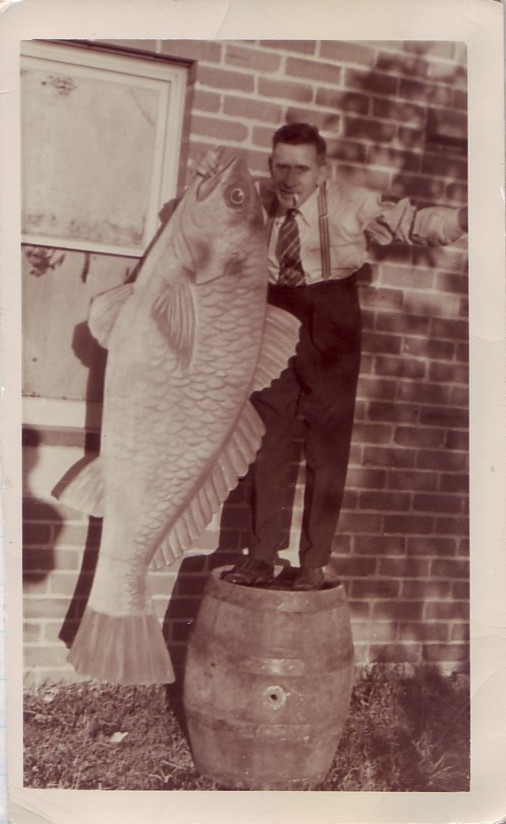
Left: Cecil Roy Selby gets some height, his daughter on the right
The inscription: to my dear wife and our mother
Margaret's birth certificate, and a card to her newly married daughter
Ode to the best organised little cemetery 'in the world'


This is my contribution to the Taphophile Tragics community.